I was in two minds whether to write about this subject because, as cyclists, we are all reluctant to dwell on the possibility of being hurt or worse while out riding. And yet, when we sign up for a club ride, or rent a bike anywhere in the world, we are asked to acknowledge we understand cycling is a potentially risky activity. What’s more, we don’t have to look far for people close to us who have suffered a serious accident while out riding. I know cyclists who have forsaken riding on roads with motor traffic because they have been so affected by the loss of biking friends. As much to reassure myself as to inform others, I thought I would explore the facts.
Luckily, most of my own accidents over the years have not involved motor traffic or other road users and I have only suffered bruising, gravel rash, broken fingers and a cracked shoulder. I will emphasize, though, that on three occasions my injuries would have been much worse had I not been wearing a helmet. Consequently, you need to be careful interpreting research like this What evidence is there that cycle helmets save lives? I found which suggests wearing a helmet has little effect on the outcome. This may only be true in the specific case of car-bike high speed collisions.
I’d never ride without a helmet whatever spurious reports suggest
I still ride on highways with motor traffic, mindful of the scenarios that expose me to risk. When I rode across Canada in 2022, I would set off at sunrise long before most people were on the road and always used strobing front and rear lights. I try to avoid riding directly into low sun at dawn or dusk as even strobe lighting can be missed by drivers coming up behind you. Similarly, I won’t ride on roads in dense fog or driving snow. Where possible, I select roads with wide shoulders but this is not a foolproof strategy for avoiding collisions as I have witnessed disturbing incidents where impatient drivers used the shoulder to overtake slower traffic.
Even on dirt roads you have to be alert to traffic – especially when its dusty
Once or twice a year, though, the news that a high-profile cyclist has been struck down by traffic while out riding makes me reappraise my choices. Most recently, it was the death of Hannah Henry the BC Triathlete in Arizona that made me look at the risks of riding in the US. There appears to be a wide variation across the country depending on the amount (or lack) of cycling infrastructure, the density of traffic and the percentage of tourists. Florida holds the unenviable reputation of being the most dangerous place to cycle returning 20% of America’s 1100 cycling deaths each year. In Canada, we suffer some 74 cycling fatalities a year.
I use a flashing back light wherever I cycle and carry one with me for rental bikes
While the numbers may sound appalling, an American study tried to put them into some sort of perspective.( Relative risk in cycling,) Apparently, you are twice as likely to be killed as a passenger or driver in a car than be killed by a car while cycling and thirty time more likely to die if you are riding a motor bike.
How does any of this data inform a cyclist of the risks involved in their sport? Well, if you cycled 2 hours a day, 300 days of the year for 50 years,( 1 million kilometres) your chances of being killed on your bicycle would still less than 1 in a hundred.
Even if the statistics convince you it’s safe enough to continue riding it is hard to pass a white Ghost Bike without feeling for the victim, their family and friends. The idea of installing a white bike near the scene of a fatal accident originated in the US about 20 years ago but has since spread worldwide. It was an Instagram post from the guy who was preparing a Ghost Bike in memory of Hannah Henry that prompted me to write these words.
Just when you think winter is done, another winter storm hits the city leaving us covered in a further 20cm of snow. And, with the temperatures plunging back into the minus 20s⁰C, there’s a huge temptation to hide inside and simply ride on the indoor trainer.
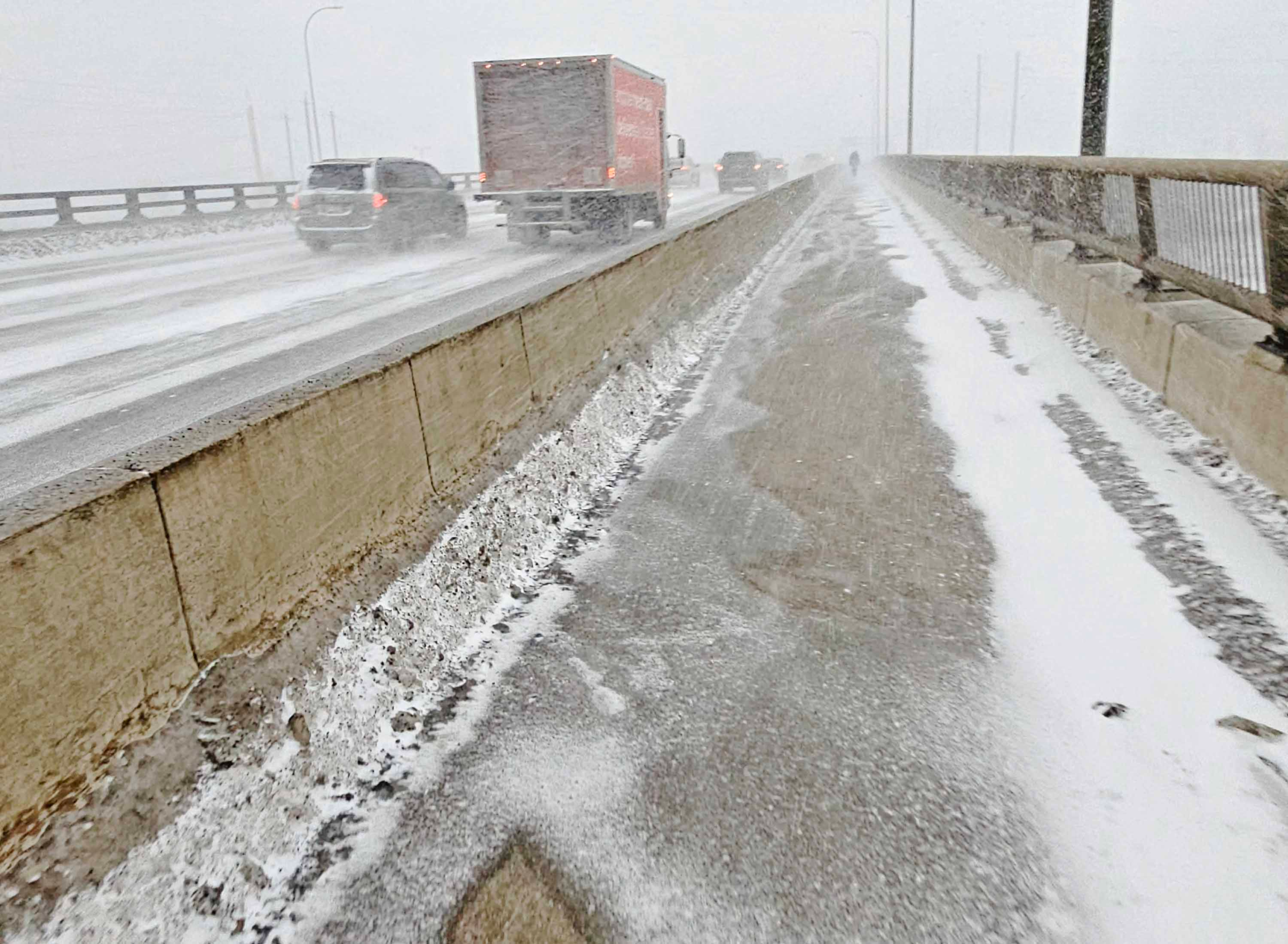
I don’t advocate riding during a storm. I found that out the hard way earlier in the year when I couldn’t keep my googles clear enough to see where I was riding, the cycle path quickly drifted over and my hands froze in the plunging temperatures. But once the snow has stopped and contractors have had a chance to clear the bike paths, then it’s just the low temperatures you have to contend with.
Where I live Downtown, on the morning after a storm the first path-clearing vehicle sweeps past my apartment at 6am, preparing the way for hardy bike commuters. And, sure enough, even with temperatures in the mid minus twenties, a few cyclists brave the conditions to ride into work. I certainly wasn’t going to head out before the sun rose, but I was interested in finding out just what had been cleared for cyclists straight after a snowfall.
Path-clearing equipment ( Photo from “live Wire” )
On leaving the apartment, I found the Bow River Trail at Prince’s Island Park was brushed clear enough to ride, although there were patches of compressed snow in places and I was glad to be riding on studded tires. Heading west on the south bank, I passed under the 9 and 10 Street bridges, travelling a little slower than normally as the patches of snow dragged on my tires. The underpasses were mercifully clear of snow.
Using an old cycle computer with limited battery life and uncertain charging, I suddenly found I had no cycling information as it had gone dormant in the cold after only a couple of kilometres. Luckily, I could start up Strava on my phone to cover the majority of the ride.
Not long after my computer gave up, the cleared path also came to an abrupt end at Pumphouse Road leaving me with a kilometre of rutted snow to the Chrowchild pedestrian bridge. I was able to follow packed tracks made by fat tire bikes but, when I fell to the side, I was brought to a halt by 10cm of loose snow. Across the river, I could see contractor crews working to clear the Bow Valley Trail there so, I guess, the route from Parkdale into downtown along the north bank, gets priority.
Uncleared section of Bow Valley Trail trail near Pumphouse Road
I had no problems in Parkdale but did have to ride on the footpath past the Angel Café because of the water pipeline construction going on there. The Angel Café was, sadly, boarded up now that the business has had to vacate and either relocate or close down completely. Further west, in Shouldice Park, 13 Avenue had been ploughed down to a firm, packed surface that was easy to ride.
At the Bowness Road bridge over the Bow, I had two options, either to continue west along the Bowness Road or to take the longer, hillier route on the north bank via Bowmont Park. As the bike paths continued to look clear, I chose to head up to Bowmont Park, naively believing that my return journey from Bowness on the Bowness Road bike path would be straightforward.
Even with the stiff climbs in Bowmont Park, I had no trouble with the cycling surfaces that were mostly bushed down to bare asphalt. I did, however, find my rear derailleur was freezing up and becoming reluctant to spring back out when I selected higher gears such that I had to nudge it with my boot heel occasionally.
Clear trails through Bowmont and Dale Hodges Parks
Apart from one or two dog walkers, there were very few trail users even through the normally crowded Baker Path just east of the Stoney Trail bridge. There were even fewer cyclists on the trails but I did encounter one man who was clearly taking great delight in getting frost on his wild man beard. On me, I could see frost building up on the back of my fibre-fleece mittens but my hands were warm enough, especially with the handlebar pogies providing additional wind protection.
Trails in Bowness Park were still snow-covered but packed firm by bikers and walkers so ran reasonably well. My bike ran better in the shallow tracks of the Park’s runabout buggy as the the boot-packed snow gave a choppy ride. Coming out of the Park, and onto 48 Ave, I got a taste of the road conditions ahead. Here, motor traffic had cleared tracks down to bare asphalt but the road margins were covered in 10cm of churned up dirty snow. When I turned right onto 85 Street where I expected to find a cleared bike lane, I discovered conditions were the same. Luckily, my lunch destination, Angel’s Drive In diner, was only a hundred metres away.
I refueled on a burger and fries, and slowly drank my coffee to warm up. My toes were tingling slightly and I could feel where my face had been exposed to the minus twenty degree cold but the rest of me was warm enough. When it came time to leave, I had been warming up for 30 minutes so found it very hard to leave the cozy environment and face the 40 degree drop in temperature outside.
Climbing over a berm of snow to reach the road, I now realized the full extent of the problem ahead. If I cycled in the road I would be holding up traffic, or I could try the sidewalk but that wasn’t completely clear and at every driveway and side road was a mess of churned up snow. I rode the sidewalk option initially but after the road curved to the east and turned into Bowness Road there was no effective sidewalk. The a parallel sideroad was competently un-ploughed so, with some trepidation, I chose to ride in the main road.
Fortunately, traffic was very light and even the vehicles that were on the road were travelling cautiously. As I set off in the righthand track, I noticed a panel van ahead of me wasn’t going much faster than I was. Cars did overtake me by moving carefully onto the hardpacked snow nearer the centre of the road but no-one showed impatience towards me.
Eventually, I made my way over the Bow River and could turn off the Bowness Road into Shouldice Park. From there, my ride back to Downtown was uneventful as the contractors had fully brushed the bike path through to Princes Island Park. Tiny flakes of bitingly cold snow drifted into my eyes before I reached my destination but I couldn’t be bothered to pull down my ski googles. For most of my ride I hadn’t even used sunglasses either as they just misted up too quickly. On a brighter, sunnier day, I would have struggled.
A cold day immediately after the winter storm
From my two-hour ride on the bike paths immediately after a winter storm I was impressed with the crews who cleared the dedicated cycle paths. In contrast, from what I saw, bike lanes that were adjacent to roads were not cleared and conditions made them unrideable. According to the City of Calgary’s snow clearing policy,( Snow clearing on bikeways ) downtown cycle tracks are Priority 1 (cleared within 24 hours) while on-street bicycle lanes are Priority 2 (cleared within 48 hours). This approach may explain the differences I experienced that day after the storm.
While motor traffic is commonly listed as the greatest concern to cyclists, being chased by a dog is pretty near the top of that list too.( How to Overcome Cyclists’ Top 6 Fears – CTS ). According to the American Kennel Club, chasing is part of a dog’s natural instinct and is one of the more frustrating behaviors for dog owners. Unless dogs are trained to ignore the temptation, they will chase, cyclists, runners, pets and wild animals. Unfortunately for cyclists, chasing incidents may be on the rise as organizations including the UK’s RSPCA are concerned about the surge of “inexperienced” pet owner following the pandemic. ( www.vettimes.com/news/vets/international/covid-19-impact-on-pets-five-years-after)
For full disclosure here, I admit to have never being a dog owner, but many cycling friends own dogs and some actually take their dogs along with them during rides either in a carrier or running alongside on a leash. It made me smile to see pictures of world class cyclist Demi Vollering carrying her four-legged friend Flo in a backpack during a training session. For a professional rider to be able to enjoy the company of a dog while out training is something special, but the interaction of cyclists with dogs covers the full range of positive and negative experiences. Ask Tour de France rider Yves Lampert who crashed on Stage 12 in 2022 when an inattentive owner allowed their dog to wander out in front of the peleton.
Demi Vollering and Flo
Car-free bike paths in Calgary are often combined with footpaths as mixed-use trails. Consequently, you will frequently encounter people walking dogs. If you give the dog and handler a heads-up with a ring of your bell and slow down to pass, then the interaction should be uneventful. City bylaws specify that unless you are in an off-lease area, your dog should be restrained on a lease no longer than 2m. However, a minority of owners will let their dogs off lease or have them at the limit of a flexible leash, indifferent to the inconvenience this poses for other trail users.
Chasing is a dog’s instinctive response to fast moving objects
More caution is needed when cycling through off leash areas, but I have found the majority of dogs will not interfere with your progress. Owners are usually very aware of their dog’s response to cyclists and take the appropriate action, either calling the dog back or physically restraining them. However, I have been chased and was once knocked off my bike when a dog ran into my front wheel in an off-lease zone.
Problems can arise when dogs are allowed run alongside their owner who is on a bike. Sure, this freedom does give more energetic dogs the chance to exercise fully. But in some cases, the dog is attached to the bike by a leash or even assisting by pulling the bike. On our crowded paths, this informal combination has potential dangers, for rider, dog and other trail users. Here, I am not denigrating the sport of Bikejoring, which evolved from dog sledding, where properly trained dogs use specialist equipment to pull bikes on open trails.
An organized Bikejoring Race
Outside the city, on rural roads, you would think there was no issue with dogs. Alberta is not like Thailand where bike-packers report being troubled by the country’s estimated one million stray dogs. Some adventurers there advise carrying a dog Dazer, a device that emits a high frequency sound that normally deters dogs find unpleasant. ( If you cycle in Thailand you have to take aggressive dogs with you. (S3 P1:E4) – CA15 ) Other riders even carry pepper spray. During my short ride through Vietnam last year, I found the dogs there were never an issue. Certainly, they were curious and came out to see what was going past but I was never chased. It may be that they were conditioned or trained not to run after the thousands of scooters and motorbikes that constitute most road traffic.
Stray dogs at a Thai temple
In Alberta, property owners are understandably concerned about the rise in rural crime (Rural crime rates consistently higher than in urban areas: StatCan | Calgary Herald ) and often protect their acreage with dogs. If relatively untrained dogs are left to run loose on a property and have free access to the roadway then problems can arise. A bored dog given little organized exercise may chase a cyclist on a public road, even when the cyclist poses no threat to the property it is supposedly protecting.
Being chased by a dog is both scary and annoying and you may not wish to take action but by reporting the incident to the local bylaw enforcement office, you may be protecting others in the future. If the dog actually nips you and draws blood, you need to take immediate action to protect yourself as well as others. Even if the wound seems superficial, you should immediately seek medical attention. Fortunately, rabies is not prevalent in the dog population here but you will be advised about tetanus protection. Also, you should take photos and report the incident so a bylaw enforcement officer can contact the property owner and investigate further.
Guard dogs are no problem when constrained to the property they are protecting
Don’t let this discussion of negative experiences with dogs colour your attitude towards our loyal companions. In five decades of cycling, I have been chased numerous times but have only ever been knocked off once and nipped on one other occasion. With the co-operation of both cyclists and dog owners we can co-exists and all enjoy our city paths and country roads in peace.
Photo Credits:, American Kennel Club, Canadian Cycling Magazine
When the resort we were staying at in Belize mentioned that they had bikes guest could use, I didn’t have high expectations. And yet, I had previously managed to get in some enjoyable rides in Florida on a beach cruiser and again on a town bike in Mexico. So, when I saw the bikes on offer, I looked past their rusty chains and fixed gears and wondered how far I could ride one in the local area? A hundred metre test ride told me all I needed to know. The cranks were straight, the chains drove smoothly and the tires were sufficiently inflated to allow me to ride at the same sort of speed I was riding on a studded tires through a Calgary winter.
My rusted fixed gear bike with coaster brake
A quick scan of the local Ride with GPS routes showed me the available rides were limited because the village at Hopkins had only 8km of coastal road and only one paved road heading inland. This road leads you back to the main north-south highway in Belize although that was a simple two-lane road. However, there was another unpaved dirt road that ran parallel to the Sittee River at the south end of Hopkins. This road was paved for the last few kilometres to the same north-south highway.
Sittee River Road – a dirt road out of Hopkins
Initially, I decided to explore the extremities of the village on the paved coast road. The southern section was characterized by large plots of land occupied by three-storey homes built by expats and foreign tourists. Theoretically, the narrow strip of beach along the shoreline was public, but there was nowhere to access it and I found my way to the Sittee River was barred by the gates of a private marina.
Bicycles similar to the one I was riding were a popular means of transport for the locals even though cars and pickups were driven by more the more prosperous and foreigners. Gasoline-powered golf carts appeared to be the transport of choice for short term visitors. Traffic moved slowly along the coast road, in part because tourists and dogs meandered out into the street unpredictably, but also because Belize has a love of sleeping policemen traffic calming bumps. Some of these bumps are so vicious that cars have to traverse them at sub-walking speed.
Trails in Bocawina National Park
Exploring in the other direction, I rode past the hotel district where building heights are again limited to three storeys and into the village which is where the local Belizeans live. By this stage I had ridden the bike about 5km and understood its idiosyncrasies. The main problem was I couldn’t even adjust the saddle height as the stem was rusted in so when I slackened the pinch nut and pulled, the saddle came off in my hands. This meant my knees were rising too high and taking more strain than normal. Also, the saddle itself was of the wide, cushiony type, favoured by non-cyclists but not suitable for riding any distance.
I was going to limit this first ride to an hour or ninety minutes but I still wanted to explore the dirt roads so headed inland on the Sittee River Road. The dirt was rutted and potholed but the wide tires (50mm) coped well and there were usually smoother lines to follow. I wasn’t aware of insects at the time but later found I had received a few mosquito bites. I was aware of the temperature and high humidity though and was wearing shorts and a short-sleeved jersey but still sweating profusely.
The bike had no bottle cage so I was resorting to the traditional method of caring a bottle in my rear centre pocket. I mused that multi-tool I was also carrying wouldn’t fit any of the bolts on the bike and I had no puncture repair kit either. Consequently, once I moved north out of the village I made sure I had a cell phone signal and the hotel number. They had several minibuses and I’m sure would have come out and recovered me if necessary.
In Sittee Village I had two options. I could either continue to the main highway, ride north on the highway until I reached the paved road back to Hopkins, or I could take a farm track that ran parallel to the main highway until I intersected the paved Hopkins Road. Opting for the latter, I soon found myself on a partly overgrown double track between plantations of coconuts and bananas. Green bushes were decorated with bright yellow and red flowers and others I recognized as purple morning glory. I splashed through muddy troughs but the dirt dried quickly on my shorts and bushed off.
An abandoned shack – off route in a coconut plantation
Luckily, the tires were soft enough and wide enough to cope with the terrain even if keeping the pedals turning was tough on my knees. After one false turn where I ended up at a ramshackle hut guarded by a dog, I managed to thread my way back towards the paved road. The return to Hopkins was easy from there but, heading back, I made a mental note to find a bike with an adjustable saddle for my next outing.
By securing a bike before 8am, I found I had a better selection but they were all the same type just in in a range of sizes. Fortunately, I discovered one that still had an adjustable saddle stem with a quick release so I could fine-tune the height while I was out. The tires were softer than I would have like so I attempted to inflate them with the small hand pump I had brought with me. I guess I managed to pump them to around 30psi before I ran out of enthusiasm.
The other items I had brought with me were a high intensity rear light and a Garmin mount for my cycle computer. Bike lights were a complete novelty in Belize as I never saw a single bike using lights day or night. Kids would ride past you in complete darkness in the village of Hopkins, navigating by moonlight. The resort locked its bikes up at sunset to prevent guests being tempted to venture out in the dark.
No-one has lights on their bikes either in the dark or during the day
I was happy to retrace the dirt route to Sittee River on my next trip but then I continued to the main highway. Named the Thomas Vincent Ramos Highway after a local civil rights activist, the road was much quieter than I had expected with only one or two vehicles a minute passing me. Moreover, the road surface where I entered the highway was smooth asphalt, in far better condition than the highways around Calgary. As I headed south, I did come across one patch of road where the tar had been stripped back revealing a chalky stone base layer but this was easy to cycle around. I had no idea when it would eventually get resurfaced as it was still in the same state when we drove past several days later. Further on, the smooth asphalt transitioned to a chip seal surface with signs cautioning “Drive Slowly”, even though the chips were well bedded so there was no reduction in my speed.
The main north-south Ramos Highway – smooth pavement with the odd bare patch
As I crossed the Sittee River, the road dipped slightly to the bridge and the gradient up afterwards gave a hint of the bike’s climbing limitations. My chain ring had 40 teeth while the rear sprocket had just 14, giving a relatively high gear ratio of 2.86 equivalent to the 9th gear of my 12-gear Trek Checkpoint gravel bike. On the smooth flat roads of the coastal plain, this wasn’t an issue. However, my destination was a pass between the hills on the road to the Cockscomb Basin nature reserve.
I turned west onto a dirt road and once I had passed some houses I was riding through tropical forest. The road undulated to cross two creeks but then started to climb in earnest at a modest 5% but this gradient was quickly too much for me on that bike. Even standing on the pedals and hauling on the handle bars I couldn’t keep the pedals turning. It didn’t help that the grips on the cruiser style bars were loose and tried to slide off so I had to hold the chromed metal below them.
Once the gradient increased it was impossible to keep the pedals turning
At least my descent back to the main highway was fast, though this time the gear span- out as the ratio wasn’t high enough. My fastest speed was around 35kph downhill while on the flat I had managed around 20kph in still air. Returning to Hopkins, I choose paved roads and faced a stiff sea breeze headwind. The high cruiser style handlebars threw your body up into the wind so the only cure was to hold the handlebars much lower down to reduce drag.
Knowing the limits of the bikes available, I planned my last ride with an easier, secondary, objective that I could ride if I got behind schedule or if the grades were too steep. In the end, it was the strong north wind that forced my hand as I could only manage 17kph when I left Hopkins to ride north up the Ramos Highway. My intended destination this time was an abandoned jail near Alta Vista on the Hummingbird Highway but this would entail my riding on dirt roads over a low hill.
At the turnoff for the dirt raid I was already behind schedule and the gentle climb on this road reduced my speed further to around 16kph. Unlike the motor vehicles which plied this road on their way towards the Bocawina National Park, I could ride around the ruts and potholes. Some 5km from the highway, I reached the turnoff where my route climbed to the north. Halfheartedly, I started to investigate this road and crossed over Silk Grass Creek on an old bridge.
Beyond the bridge, the route climbed into an old plantation but it wasn’t clear whether road access was private or public. Threatening signs warned against trespassing. By that stage I had already decided to ride to my secondary destination, the Bocawina National Park so I backtracked to the junction and continued heading west. Nowhere was the gradient steep but the road climbed gradually to the park entrance.
Old bridge over Silk Grass Creek
Returning back down the dirt road, I benefitted from the gentle gradient and managed to maintain 20kph. Then, with the wind at my back, I maintained 22-24kph on the paved road but I still faced a headwind component on the final run into Hopkins.
After 2 ½ hours of riding I had pushed my endurance on that bike to a comfortable limit as my knees and my sit bones ached from the unfamiliar positions. My heart rate data indicated some 154 TSS of training effort which was about the same as for riding a gravel bike with studded tires around Calgary in winter. All in all, it was well worth taking the risk of exploring my surroundings in Belize on an ill-fitting bike but I would advise anyone contemplating taking a hotel bike to increase their cycling range gradually before embarking on an epic excursion.
Even so, never underestimate the possibilities with a humble hotel bike!
I have ridden this circuit on two occasions, once in November before the snow arrived and once in January during a sustained mild period that had cleared much of the snow that fell in November and December. Part of the route, I have also ridden in early summer. In the summer and November, I rode a lightweight gravel bike with 45mm tires, a top-tube bag and two bidons while on the January ride I took my winter gravel bike that is heavier with its aluminum frame and 40mm studded tires. I may try to squeeze 45mm tires on this when the current ones wear out.
The 87km route I planned encompassed 37km of prairie gravel road that I hoped would run well if the snow had been ploughed and the residual snow had melted sufficiently. I expected the surface to drain better than on asphalt roads. Apparently, Rocky View County does plough these gravel roads if the snow is more than 10cm deep so I was optimistic.
During the November ride the temperature had been just 5⁰C with a light wind of 10kph from the northwest. For the January excursion, the temperature was predicted to exceed 15⁰C, tropical for winter in Alberta, though the westerly wind was expected to pick up during the day to 20+kph on the return journey.
From downtown, the quickest way to south Chestermere threads south east via Inglewood and then alongside the Western Headworks Canal to 50 Ave SE. Virtually all of the cycle paths and roads were snow- and ice-free even in January thanks to the snow-clearing contractor. Hard ice remained in a couple of spots like the underpass entrance at Highway 2. Additionally, there were sheets of melt-freeze ice across the path downtown. Even with the high daytime temperatures, we had still experienced an overnight ground frost.
On 50 Ave SE, in the places where there was no sidewalk, I would usually ride the informal track cut by other cyclists along the grass on the north side of the road. In January, the rough track was a ribbon of hard-packed snow and ice even though the snow either side had melted leaving bare ground. Consequently, I reverted back to riding on the paved road. At 52 St SE you turn south over the railway track and then dog-leg east at 61 Ave SE where there is a convenient sidewalk on the north side of the road that conveys you over the Stoney Trail highway to 84 St SE. Turning north, you re-cross the railway and then turn east on Township Road 240 that would be a continuation of 50 Ave SE if you had not crossed into Rocky View County territory.
Worn margins of Township Road 240
Had this road been in Calgary and not Rocky View County, then it is likely it would have been paved. This is possibly the closest stretch of gravel road to Downtown.
The gravel was dry and firm, though of slightly different texture to its pre-snow feel. Road margins were barer and slightly browner in colour but the lateral surface ran faster than the stonier central area. I found it was easy to maintain 20 to 22 kph, although by then I did have some wind assistance.
Continuing eastwards, you cross Rainbow Road that runs up to Chestermere and Township Road 280 is asphalted as far as Range Road 281, located southeast of Chestermere. This gravel road runs for 10km due south over two paved east-west roads. Your speed here is greatly affected by the quality of the gravel and the wind speed and direction as the terrain it is very exposed. I had no wind assistance here in January as the wind was light and westerly but I managed to maintained 18 to 20kph because the gravel surface ran well. Even where it was moist from snow melt, the road still ran quickly. On my “summer” gravel bike, the wider 45 mm tires seemed to float over the surface better giving me 2 to 4 kph more speed.
Some ice on the margins of Range Road 281
Where the road rose in gentle inclines, there was hardpacked snow on the surface but mostly only on the north-facing slopes. With the Rockies clearly visible some 80km out to the west, this section of gravel road is a delight to ride in those conditions, just as it had been in the summer and in Autumn.
At the intersection where you turn eastwards onto Township Road 230, there was more hardpacked snow. The road here is in the lee of trees surrounding the property immediately to the south. As well as breaking the wind allowing snow to build up, these trees also throw shade onto the road that slows down the thawing process.
More ice in the north-facing inclines
Then, on Township Road 230, the surface was stonier and slower but the wind in winter is often at your back helping you maintain speed. At the tiny settlement of Indus, the road is paved for the industrial units until you turn north on Range Road 275 where the surface is rough and slow.
The bridge over the canal on Township Road 232 is a convenient place to stop and admire the view before turning again northward on Vale Road immediately southwest of Landon. Finally, you intersect Railway Avenue that parallels the former railway into Langdon which closed some three decades ago. Only on the very edge of the built-up development will you find the road paved, just before you pass the supermarket and Tim Hortons.
I prefer the independent coffee shop called Prairie Grounds on Centre Street. At lunchtime, you will find students from the nearby high school escaping for a coffee and muffin here, but there is always a comfortable chair for the weary cyclist.
Prairie Grounds cafe in Langdon
When you leave, you turn west on Bradner Avenue and keep going back to Vale Road that defines the current western limit of the town and is paved up to the Glenmore Trail. North of that road you continue on the unpaved Range Road 273. You pass a few rural properties and then at an intersection make the turn west for home back on Township Road 240. Here, when the west wind blows you feel its full force knocking even more kph off your speed.
Icy puddles on the paved path around the Zoo
You have 5km of Township Road 240 but the last 2km section is paved, as is Range Road 282 that leads you to the south shore of Chestermere Lake. Building activity in the new development there leaves the roads muddy with deep puddles when the snow melts. However, the cut through on South Shore Drive connects to Rainbow Road that takes you north on the western side of Chestermere to the main road into Calgary, 17 Avenue.
The route on 17 Avenue follows a wide shoulder but there are points after Belvedere where you either cycle in the traffic or on the sidewalk. Eventually, on the section known as International Avenue, you need to cross to the south to follow the bike path on 19 Avenue that is quieter. 19 Avenue leads you to the Boat People memorial above the Bow River and the dedicated bike path drops you under 17 Avenue to follow the Western Headworks Canal, over Highway 2 and around to the Zoo. There, the paved path was interspersed with a mix of melted ice and puddles.
In January, with a headwind on the return, the whole journey took me 5 hours and 5 minutes with a moving time of 4 hours 31 minutes at an average riding speed of 19.3kph. This compares with 4 hours 10 minutes with a moving time of 3 hours 45 minutes and speed of 23.3kph on my lighter Trek Checkpoint in November. The difference in speed can be accounted for by the lighter, faster bike, dry, ice-free road surface and the lighter winds in November.
So is the gravel rideable in winter? If you pick a period after a Chinook waming you may prove to be as lucky as I was!
From the beginning of my return to serious cycling and structured training a decade ago, I determined I would need two things to improve, power data and an indoor trainer. Even though I had been relying on a heart rate monitor during my running years, I had read that there were better ways to measure training effort on a bike. Also, I learned there were more productive ways of training than merely grinding out kilometres on the road.
Relative to the cost of a new bike, power meters were expensive. Ten years ago, $2,500 bought you a decent intermediate level carbon road bike with 10 Shimano 105 gears but the cheapest power meters were single-sided crank meters costing a further $700. Having laid out that expense, I sought an indoor trainer and decided my best option then was a $300 Kurt Kinetic liquid roller wheel that was essentially mechanical but had an upgrade so it that could transmit power data to an app via blue tooth.
My current trainer is a “dumb” fluid wheel device that is no longer in production
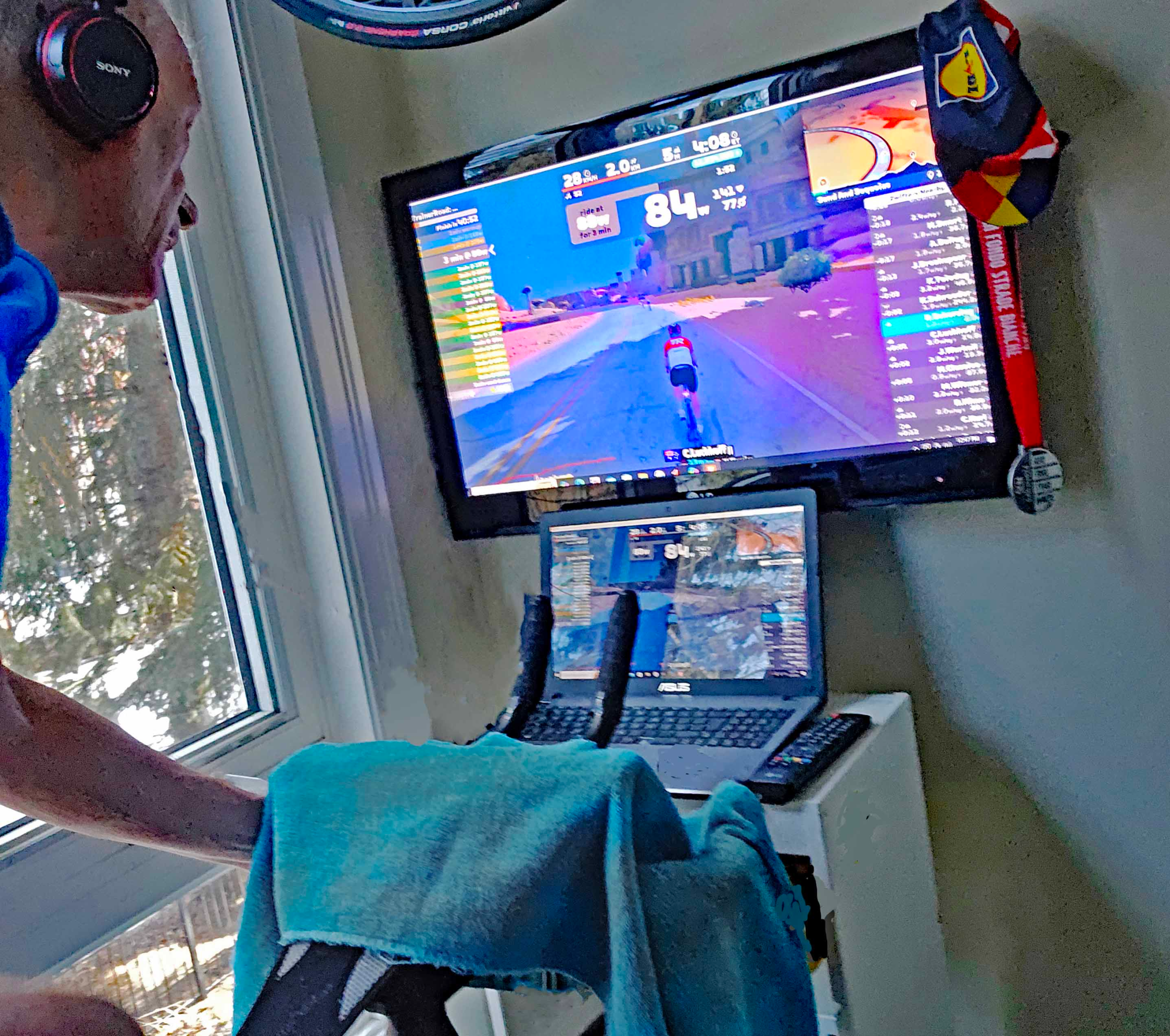
My initial indoor training comprised watching Youtube videos of cycling in the Alps whilst trying to follow the power profiles of a free British Cycling training program that I had printed out on paper. I joined the Zwift platform early on but back then, Zwift didn’t have much in the way of training programs so I moved to using Trainer Road in addition. At least then I could follow the power trace on a separate computer screen and ride in the Zwift virtual world. For Zwift and Trainer Road, I was able to use the power data from my left pedal crank.
My training power data is from a single sided crank power meter
Having data from just on crank wasn’t an issue unless there were particular training instructions to concentrate on just my left leg for example when I would notice big differences in the reported power for the same perceived effort. At one point, I had enlisted a personal trainer to analyze my riding and give me feedback. He put me on his Watt Bike that recorded effort from each pedal. The results showed that, like most people, I had an imbalance of effort between left and right sides and I always wondered how that would impact my true power output on a bike where only data from the left pedal was recorded? If my left leg generated less effort, wouldn’t my true power be underestimated by a single side power meter? How did more modern “smart” trainers differ in this respect?
The key feature of a smart trainer is that it links in with the terrain and conditions being projected in the virtual world on screen. If the rider begins to climb a virtual hill in the same gear and cadence (RPM), then their power will need to increase or they will slow down as on a real hill. On my non-smart trainer if I continued in the same gear and cadence my power would remain the same and my speed would drop on a climb. I would need to increase cadence or gearing to generate more power to climb at my previous speed. This is contrary to the real-world situation where you would likely reduce gearing ( go to a bigger sprocket).
Some high-end trainers can simulate gradients by raising the front forks
Some current high-end trainers have an additional features where the bike front forks are raised to simulate the actual incline of a hill, much in the same way that running treadmills can incline to simulate running up a slope. Also, there are trainers that simulate the lateral and fore and aft movement of the whole bike. Lateral movement is nothing new as Kurt introduced this feature on a machine more ten years ago but it was a feature that never really caught on. Similarly, there are fans to simulate windspeed that vary with the video scenario. The jury is out as to whether these extra features are really worth the expense. The harsh reality is that you are on a training bike in your basement, not riding to a mountain pass in the Andes.
Having researched all that was currently available I needed to sift through the features that would actually make a difference to my training experience. Unlike most indoor riders, I suspect, I was someone who could stare fixedly at a mechanical power reading and stop watch on a gym fixed cycle and follow a printed interval program. I did find blasting loud music through headphones helped. Oddly, headphones, much like pedals, are left as an individual choice with indoor training systems even though some systems, like Pelton, have a screen for the video. For my video screen I have always used the television that was superseded from my sitting room and I powered by an old laptop with a gaming chip.
Trainer system with a proprietary screen attached
So, here are the potential features of indoor cycle trainers:
Power at the drive hub displayed.
Power at the drive hub automatically varied by the virtual terrain.
Power balance between the left and right pedals or cranks displayed.
Cadence displayed.
Lateral movement of bike to simulate sway.
Fore and aft movement of bike to simulate surge.
Raising of front forts to simulate incline.
Variable fan speed to simulate speed of bike.
For the visual display, there are several options:
Wall mounted television
Stand mounted proprietary computer screen
Stand mounded laptop
Jagged yellow trace shows how hard it is to follow a power profile manually (non-ERG mode)
The quality of the perceived ride is dependent on a number of the trainer’s other specifications:
Weight of flywheel – generally it’s agreed that a heavier flywheel is better to simulate inertia of wheels on a real bike.
Wheel on or wheel off. Higher end trainers are all wheel off versions where the bike rear wheel is removed and the rider drives a resistance unit. The resistance unit may have a cassette or a single sprocket like the Zwift hub system that simulates gears. In cheaper systems, like my Kurt Kinetic, a trainer tire is fitted to a rear wheel and drives a roller by friction.
Finally, the quality of the data out will impact the overall cost. A system that claims power accuracy to within +/- 1% will cost at least twice the price of a machine delivering +/- 2%. Cheaper machines are likely to be only accurate to 5% which become significant if you aim to train in zones very close to your sustained maximum power output or Functional Threshold Power.
Even a 1% gradient in the virtual world drives a demand for more power from a smart trainer
Given this plethora of options, how can I choose what I need and not just go for what I want because it is new and available? Firstly, I’ll look at power data and control. All machines give power data and, for me, an accuracy of +/- 2% (about 5 Watts at my FTP) is probably adequate. While it may be interesting to know what the balance of output between my left and right legs, there’s not much I would be able to do with that information so it’s not something I am going to regularly need.
I guess the key question regarding power is whether I want “smart” control with the power demand automatically being changed by the training program, or in the case of programs like Zwift, by the virtual terrain. People I have spoken to insist it is much easier to follow a training program, particularly in the so-called ERG mode where the program sets the power level the rider has to maintain. If your cadence slows, power is maintained by forcing you to increase crank torque. The advantage here is that you are no longer having to chase the power level by pedalling faster or changing to a higher gear ratio.
Owners of smart trainers report that you certainly know you have hit a hill in the virtual world when riding in the resistance mode of a smart trainer. This advantage alone justifies a smart trainer in the eyes of many athletes. Whether you always stay in ERG mode for intense training intervals is up to you. Some athletes suggest using resistance mode for intervals at VO2 max. Either way, the option is open to you with a smart trainer and, as someone said, I would rather use the small amount of extra brain oxygen needed to use dumb trainer in my leg muscles!
As for simulating the incline of a hill by lifting the front forks, like many, I am as yet unconvinced. Unless you are deliberately riding killer gradients, the few degrees of inclination of most hills are barely noticeable in terms of bike position. According to Bike Calculator , a cyclist generating 150watts should be able to maintain 28kph on the flat but to travel that fast up a modest 2% (1.12 degrees) hill the power would almost need to double to 285Watts. Now, it would be hard to feel a 1 degree slope if you were stationary but you’d quickly notice the extra power needed if you wanted to maintain speed!
A fan emulating wind speed also seems an unnecessary extra to me. Cooling fans are important especially in summer of it you are in a windowless basement. However, if you live in Calgary, you only need to crack a window in winter to get the temperature down.
Typical sub-$1,000 smart trainer used without rear wheel
So, do I need a smart trainer? I think the answer is yes because I ride indoors three or four days a week in winter on structured interval rides and group endurance rides. I don’t think I could justify spending over $1,000 but there are several excellent sub-$1,000 trainers out there. In Canada we do appear to be paying a premium for these machines though compared with the prices charged to Europeans and Americans. The most popular mid-level trainer in the UK is currently selling for 450GBP (840CAD) including tax whereas in Canada it is 945CAD with tax. The US price is around 582USD or 810CAD. Short of going abroad and importing the trainer myself, I am resigned to paying the premium.
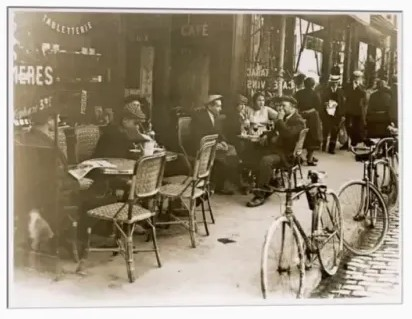
Many sporting activities have become inextricably linked to a particular beverage. Take for example rugby/beer, skiing/gluwein, ballooning/champagne, polo/gin and tonic. Cycling has long been associated with coffee and this article looks at that relationship and how it developed.
Coffee as a drink has been around much longer than cycling as a sport. Even ignoring coffee consumption by central Americans pre-conquest, coffee shops were thriving in the cities of Europe the late 1600’s. Back then though coffee shops were more associated with intellectual activities, like debating and commerce, than sport. Cycling as a popular sport and practical means of transport was only really became possible after Harrison’s invention of the Rover Safety Bicycle in 1885. “Safety” here was an inditement of the alternative bicycle, the Penny Farthing where the rider had to balance on a saddle at head height, set as it was over the huge front wheel.
Early Tour de France Racers
Very early in the development of modern cycling on safety bikes, people realized you could actually travel significant distances, so very quickly epic endurance races were established, often sponsored by the media of that era, the daily newspaper. In the 1890s European races like Liège-Bastogne-Liège (250km), Paris-Brest-Paris, (1,200km), were first run and then the first edition of Tour de France appeared in 1903. That first Tour covered 2428km in just six stages with competitors often riding through the night, unsupported and fueled by normal foods, and drink including wine and cold coffee. Coffee warded off drowsiness to some extent and so the relationship between cycling and coffee was set.
By the late 20th Century, sports governing bodies were becoming concerned about the sheer amount of caffeine endurance athletes, including cyclists, were consuming and so for a twenty-year period, 1984 -2004, caffeine was a monitored drug with strict limits for Olympians. Steve Hegg, an American gold medalist track cyclist was famously dropped from the American team for being caught over the caffeine limit in trails for the 1988 Olympics. Professional cycling was mired by scandals involving far more potent drugs than caffeine over that period and barely anyone noticed when unrestricted use of caffeine was allowed again in 2004.
Caffeine use was severely restricted from 1984-2004 by the ICU and WADA
In recent years, coffee has been happily reunited with professional cycling. Segafredo, an Italian coffee company, sponsored the American team Trek until 2023 and the Italian manufacture Rocket Expresso supplies Bahrain Victorious with high end coffee machines. Continuing the coffee theme after retiring from professional cycling, Christian Meir and wife Amber set up cafe in Girona, Spain, that is a favourite haunt for the numerous pros who train in the city. And, slowly, the café and cycling culture that began in France and Italy decades ago, eventually spread reaching Britain, northern Europe and north America by the early 2000’s.
Bahrain Victorious and Rocket Expresso in partnership (BettiniPhoto)
Nowadays, cycling club rides the world over feature a café stop, before, during or after a ride. Capitalizing on this particular aspect of cycling, retired British pro Matt Stevens has evolved an entertaining series of Youtube videos such as https://www.youtube.com/watch?v=R30utXEe7mE where he meets up with a celebrity cyclist and chats about their careers as they ride out to a café and then return home. The café stop is an integral part of the show as the celebrity will have chosen one of their favourite locations.
Chrystie’s Coffee House at Wolf Willow in southern Calgary
I was thinking about this and wondering where I would lead Matt in our neck of the woods? As I live Downtown, some of the best coffee stops like Alforno Bakery, Brooklynn’s Café, Angel’s Café and Aggüdo Coffee Roasters are too close to include in a two- or three-hour ride. Further out of town I would certainly include Chrystie’s at Wolf Willow, Good Earth in Cochrane and Prairie Grounds in Langdon. In winter, these are at the limits of where I would tend to ride but they make fantastic refuges on a cold day! The only downside is having to dress back up to go outside and face the ride home.
The weather forecast predicted strong winds, snow accumulations and dropping temperatures in the next couple of hours but I decided to head south down the Bow River Trail anyway. There was a café in Chapparal that looked like a good destination and I had been turned back once before by pathways covered in black ice. On that occasion I had slid off the bike twice.
Setting off this time, I found the cycle path conditions were fine; in places there were patches of ice after a return to cold weather following the weekend thaw, but the tire studs gripped well. A steady tailwind reminded me that snow was due to arrive from the north but also helped speed me on my way to Fish Creek Park where I stopped off at the wonderful heated restrooms in anticipation of completing the remaining eight kilometres to my destination.
Clear conditions at Diamond Cove on outbound leg of journey
However, in the space of ten minutes the wind picked up and swirling snow was being driven downriver, rapidly obscuring the bike trail. Expecting conditions to worsen, I made the decision then to turn back. Just how long could 18km taken me to get home?
Within a few more minutes the conditions deteriorated further and at Carburn Park, I was having difficulty seeing through my sunglasses as they were both icing up and steaming up simultaneously. I tried without glasses but biting cold ice crystals stung my eyes; these were not big fluffy snowflakes. I had ski googles though these fared no better as I discovered the tiny ice particles were being driven through the ventilation slots so snow was accumulated on the back of my lenses.
No time to linger at the brazier in Carburn Park
My clothing was good down to -20⁰C but I hadn’t realized the temperature was plunging to minus 14⁰C and the wind picking up to 50kph, far worse than the forecast had predicted. I lingered under every highway bridge and attempted to clear my goggles but my hands froze each time I removed my gloves. Luckily, the small battery powered hand warmers restored my circulation enough for me to be able to grip my handle bars but within a few minutes my vison was gone again. At times I couldn’t see the path at all and just aimed for the gap between the cottonwood trees.
As the snow built up on the path, I had more and more difficulty making progress. Drifts up to 30cm deep pulled me to a standstill while loose snow on ice caused me to slide. The wind tugged forcefully at my wheels whenever there was a cross component. As I approached the Inglewood Bird Sanctury, I was effectively staring at a white screen and riding by the feel of the snow under my wheels. All the while my face and head were starting to become numb even though I was wearing a ski helmet and face scarf.
Cars in the parking lot suggested the Sanctuary was open but the approach was covered in ice and blowing snow so I had to push my bike across the yard to the entrance. Abandoning the bike by the doorway, I pushed my way in to the brightly lit lobby where one of the staff gasped in surprise as I shook ice and snow off my clothing and moved to a bench to warm up. While snow swirled around the porch behind me, I sipped slowly on hot berry drink from the Yeti mug that I had retrieved from my bottle cage and contemplated my next move.
Feeling began to return to my fingers and my headscarf unstiffened from its frozen state but then became damp and soggy instead. My eyes ached from staring at whiteness and from the stinging ice, and my neck and shoulders ached from being tensed up in anticipation of another fall. Should I call for a ride home or wait out the storm. I had no idea how it would develop.
Eventually, visibility was good enough to see the fifty metres across the parking lot once again and I thought the wind had lessened slightly so decided to press on home. Most of the route from there was more sheltered either by the trees in Pearce Park or the high-rise buildings of downtown. Even so, I still couldn’t ride without eye protection so my vision was blurred once again and the drifts were deeper. Apart from one or two dogwalkers, no one else was outside and no-one was attempting to clear the trails.
An electric-powered fat-bike overtook me as I approached Eau Claire Plaza and, I mused, it was certainly better suited to the conditions. I wondered how the other bike commuters I had seen earlier in the day would fare now they had to return home in these conditions? I’m sure I would be calling for a lift I faced a return ride that afternoon. My return journey of 16km had taken me over one hour and forty minutes and, even then, my bike computer went dormant two kilometres from home when the battery became too cold.
I think I learned my lesson not to distrust the weather forecast as conditions became even worse than the prediction that I had played down. In future, if I see that If storm force winds are predicted with heavy snowfall and rapidly sinking temperatures, then I will assume the outcome will certainly a blizzard and remain indoors!
However early the first snow arrives in Calgary, it’s usually here to stay by late November, though you can never be sure what the Chinook winds may do. The majority of recreational cyclists stop riding for the season once the temperature drops below 5⁰C, even before that snow arrives. I can confirm this by observing the pattern of use in the bike room of my apartment building. Of the fifty or so cycles stored there, only two or three won’t be gathering dust for the next 6 months.
A hard core of commuters cycle into Downtown year-round
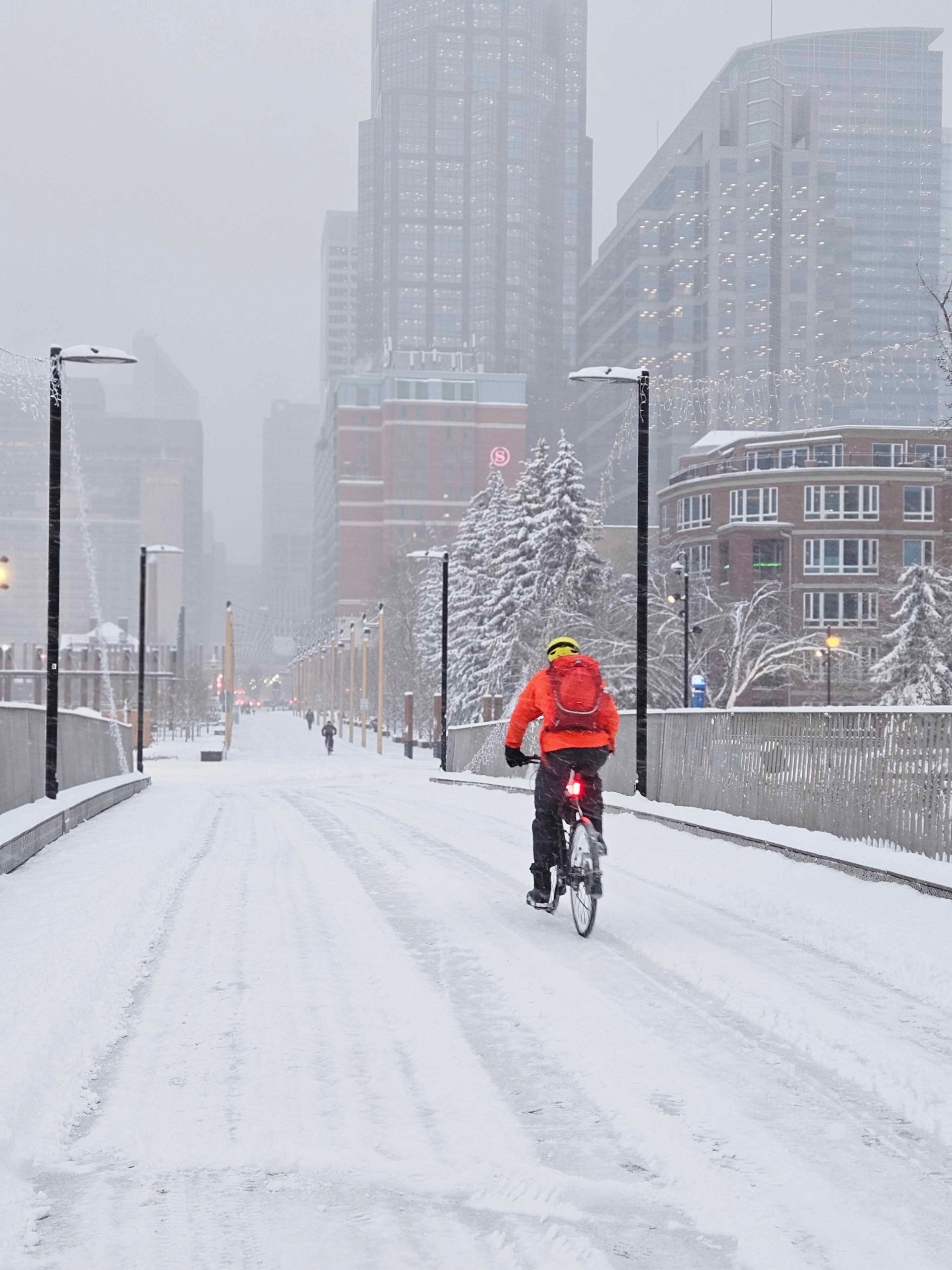
Despite the dearth of causal riders, a hard core of commuters continues to ride into downtown year-round. The bikes they use range from fat tire electric bikes to skinny tired road bikes but you frequently hear the clicking of studs on paving so some obviously change their tires for winter. Even on the bitterest mornings or when snow is flying, I see riders passing my apartment window. As the casual riders have long since stopped riding, these commuters must have chosen to cycle for reasons of convenience, economy or health.
Riding the trails outside commuting times, you tend to see few other people riding unless the sun is out, the temperature above freezing and the trails are clear. Although I try to get out in all conditions, the duration of my rides is certainly reduced by low temperatures; two or possibly three hours is enough unless I stop midway for a coffee break and warm up. Consequently, I have a selection of cozy cafés earmarked in strategic positions on the edge of the city or surrounding communities like, Chestermere, Langdon, Cochrane and Airdrie.
Many cyclists don ski helmets and goggle to counter extremely cold temperatures
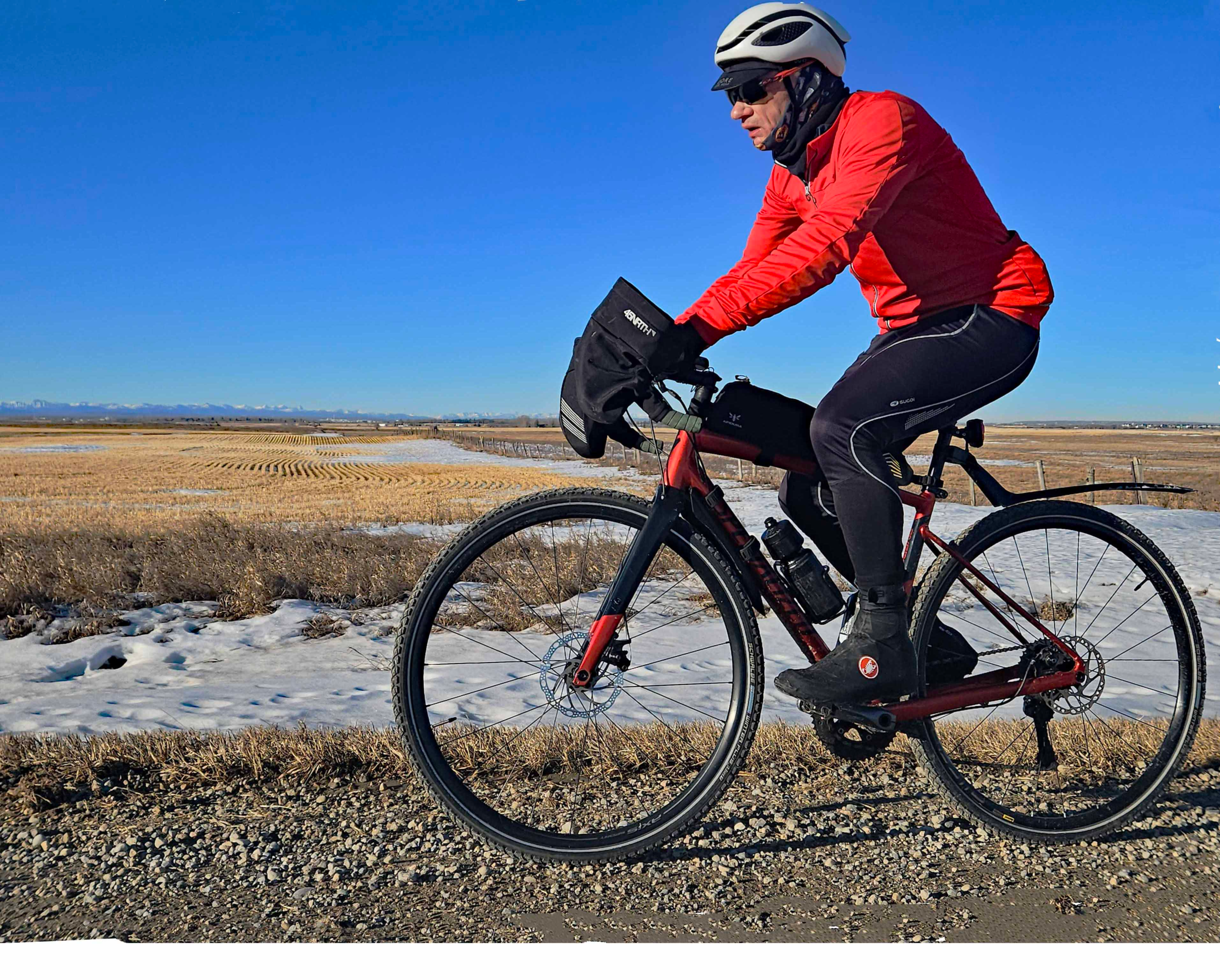
Even when I think I am dressed appropriately, sometimes a biting cold wind will surprise and chill me. In the past, cold hands and feet limited my rides but I have overcome this problem by investing in insulated cycling boots and handlebar “pogies”. Pogies are insulated coverings that fit over the brakes and gear shifters to shield your gloved hands. I wear fully-finger mountain bike gloves for temperatures between zero and 10⁰C but winter gloves when the temperature is below zero. Just for good measure, I drop a rechargeable handwarmer in each pogie when the temperature nudges minus 10⁰C.
Many riders keep their heads warm by wearing a ski helmet and goggles as the temperatures plunge. The extra bulk and weight of a ski helmet won’t make much different to your speed by then as you will also be wearing a heavier jacket, pants, gloves and boots. You could used heated socks in lighter boots and this combination suits those who want to continue with cleated boots. However, there are specialist winter cycling boots, from companies like 45 North, that resemble snowboard boots but which are fitted with mountain bike cleats too.
Special purpose insulated winter boots with cleats
Layering is best for leg warmth as your legs are generating most of your muscle warmth while riding and if you opt for heavy ski pants you can end up sweating, particularly when the sun is out. I wear thin cycling tights over my bib shorts for temperatures between freezing and 10⁰C and thicker overpants when the temperatures drop further. Below -10⁰C, I add a polypropylene or smart wool layer under my outer cycling pants. I have cycled in temperatures in the -20⁰Cs and lower and wore skipants with underlayers on those occasions.
Surprisingly, I find my torso can get overly warm if I layer up with a down-type quilted coat before the temperature is in low negative territory. It is usually my shoulders and upper arms that feel the cold first so the popularity of sleeveless gillets has always puzzled me. If it is cold enough to need a quilted gillet, then I need some form of arm protection too. Again, I tend to layer up, initially with a long-sleeved vest under a long-sleeved cycling jacket and as temperatures drop, I will add a mid-layer, usually a mountain bike jacket. Only when the temperature sinks below -10⁰C will I consider a quilted layer under my cycling jacket.
For face protection, I rely on a winter “Buff” to cover my chin, nose for temperatures down to -15⁰C but I wear a balaclava for full face cover when its colder. I also wear ski goggles over my glasses which is fine until I have to stop at crossings and traffic lights where they start to fog up. In these sorts of temperatures, you also begin to get problems with your bike. Brake and gear cables can freeze if there is a trace of moisture in the Bowden cables, or battery shifters rapidly lose their charge. And, of course, there is the issue with to much or too little tire friction.
Layering for legs is good because temperatures can rise significantly under Chinook winds
Very cold snow, below -20⁰C is extremely grippy with the texture of fine sand so a thin layer of this adhering to pavement causes no issues, even to unstudded tires. New studded tires will grip well on bare ice but it is the combinations of snow and ice types that we see in Calgary that are problematic. Particular care needs to be taken on roads and when crossing sidewalks.
Sometimes its much safer just to get off and walk
In near freezing conditions, the weight of road and foot traffic will crush newly-fallen snow into an underlayer of hard ice. If left untreated, subsequent colder snow may not adhere but build up to a depth of many centimetres as loose snow. Even when driven on, this new snow may not pack down but just be displaced on the slippery, base layer. When a cyclist attempts to ride through this covering, even with studded tires, the loose snow resists movement turning and lifting the front wheel off the hard layer rendering the studs ineffective. The loose snow, now under the tire, slides rapidly sideways on the ice taking the front tire with it and a fall is inevitable.
Even a studded tire will slide sideways when churned cold snow lies on a layer of hard ice
The only way to avoid falling is to recognize these conditions and to avoid roads, paths and sidewalks covered in heavily churned dry snow because the first patch of ice underneath will cause trouble. Walking and pushing your bicycle here may be your best option to avoid a painful tumble. But if you have a good sense of balance, don’t let this talk of falling deter you from making use of the winter bike paths – the City and their contractors do a great job of allowing us to ride year round if we want to.
The City does a great job of keeping bike trails clear for us to enjoy
The only reason cyclists used to ride stationary indoors was to continue training during poorer winter weather. From the earliest days of the bicycle, a three-roller frame trainer was invented where the rear wheel sat between, and drove, two rollers while the front wheel rested on the forward roller. As the bike was unsupported, the rider had to maintain balance by pedalling smoothly and subtly adjusting their body position. By the middle of the 20th Century, rollers had evolved little but fixed stand versions were available and there were others where the roller resistance could be adjusted.
In parallel, the stationary exercise bike began to become popular as a general fitness machine but was not used by serious cyclists as its upright stance and pedalling motion did not emulate that of a racing bike. Essentially, you had some sort of variable friction drive and a heavy flywheel to smooth out rotation. For the causal user, who wanted to be entertained, the options were limited to watching television or playing music on the radio or stereo system. For those users actually interested in cycling there were VHS tapes of cycling events you could play on a (small screen) TV but you were never synchronized to that limited artificial environment.
The stationary bikes could record effort expended and virtual distance ridden but you had to write down what the machine had recorded and transfer the data to your paper logbook to make any meaningful training sense of what you had achieved. At the time, training knowhow was mostly the preserve of coaches and mysterious to most of us.
Indoor training began to be taken more seriously, after South African Johnny Goldberg proved a static trainer could be used in an effective program for endurance cyclists in the mid 1980’s. Ironically, his approach eventually evolved into the modern “Spinning” industry that is more geared towards general- and not cycling-specific fitness.
Then, in the 1990’s, coaching programs gradually leaked out in hard copy books by fitness icons like Joe Friel The cyclist’s training bible – Google Search. You still had to plan out you own schedule and record it manually in a note book or on early personal computers. Only serious riders had the time and interest to add this chore to their riding task.
One of the first comprehensive training manuals – published in 1996
The modern “smart” indoor trainer has its origins in the early 2000’s when companies in the US and Europe introduced models with electrical resistance control to follow training programs that were displayed on computer screens. By 2010, systems were launched that could control the bike wirelessly. However, it was Zwift’s launch in 2014 that gave indoor cyclists the new experience of being able to ride in a virtual world with others where their speed was controlled by the effort they exerted on the stationary trainer.
From the early days of Zwift there were races that have now developed into serious “e-racing” events with a world championship. Riders who were successful in the virtual world have even been selected on that basis to join real professional cycling teams. Also, some cyclists have found roles as a professional e-bike racer.
Zwift UK National Championships 2019
For those of us not at professional level, the social aspect of using apps like Zwift and Peloton is a big plus. Countless riders meet up in virtual groups every day for training rides or races. When my twin brother and I were going to participate in a 10-day ride from Ottawa to Halifax, we would train together for an hour a week on Zwift even though he lives in London UK. That way we could see what level of fitness each of us was at and encourage each other to stick with our programs.
Where is indoor cycling destined to go? For some it has already taken over most of their total riding effort. They can avoid the risks of riding in traffic or poor weather and still meet with similarly minded riders. As a training tool, it is more efficient and safer than working outside and you don’t have to wash your bike afterwards. Others, enjoy the social aspect of riding on Zwift, even if they are not following a specific training program. Overall, I think the level of participation on indoor platforms will tend to reflect the level of interest in outdoor riding on mechanical bikes. I write “mechanical” because I don’t think the rider who uses an e-bike exclusively is likely to consider riding indoors. I may be wrong?