
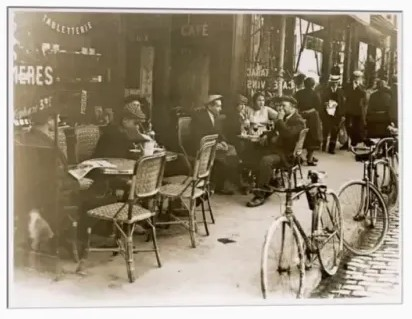
Many sporting activities have become inextricably linked to a particular beverage. Take for example rugby/beer, skiing/gluwein, ballooning/champagne, polo/gin and tonic. Cycling has long been associated with coffee and this article looks at that relationship and how it developed.
Coffee as a drink has been around much longer than cycling as a sport. Even ignoring coffee consumption by central Americans pre-conquest, coffee shops were thriving in the cities of Europe the late 1600’s. Back then though coffee shops were more associated with intellectual activities, like debating and commerce, than sport. Cycling as a popular sport and practical means of transport was only really became possible after Harrison’s invention of the Rover Safety Bicycle in 1885. “Safety” here was an inditement of the alternative bicycle, the Penny Farthing where the rider had to balance on a saddle at head height, set as it was over the huge front wheel.

Very early in the development of modern cycling on safety bikes, people realized you could actually travel significant distances, so very quickly epic endurance races were established, often sponsored by the media of that era, the daily newspaper. In the 1890s European races like Liège-Bastogne-Liège (250km), Paris-Brest-Paris, (1,200km), were first run and then the first edition of Tour de France appeared in 1903. That first Tour covered 2428km in just six stages with competitors often riding through the night, unsupported and fueled by normal foods, and drink including wine and cold coffee. Coffee warded off drowsiness to some extent and so the relationship between cycling and coffee was set.
By the late 20th Century, sports governing bodies were becoming concerned about the sheer amount of caffeine endurance athletes, including cyclists, were consuming and so for a twenty-year period, 1984 -2004, caffeine was a monitored drug with strict limits for Olympians. Steve Hegg, an American gold medalist track cyclist was famously dropped from the American team for being caught over the caffeine limit in trails for the 1988 Olympics. Professional cycling was mired by scandals involving far more potent drugs than caffeine over that period and barely anyone noticed when unrestricted use of caffeine was allowed again in 2004.

In recent years, coffee has been happily reunited with professional cycling. Segafredo, an Italian coffee company, sponsored the American team Trek until 2023 and the Italian manufacture Rocket Expresso supplies Bahrain Victorious with high end coffee machines. Continuing the coffee theme after retiring from professional cycling, Christian Meir and wife Amber set up cafe in Girona, Spain, that is a favourite haunt for the numerous pros who train in the city. And, slowly, the café and cycling culture that began in France and Italy decades ago, eventually spread reaching Britain, northern Europe and north America by the early 2000’s.

Nowadays, cycling club rides the world over feature a café stop, before, during or after a ride. Capitalizing on this particular aspect of cycling, retired British pro Matt Stevens has evolved an entertaining series of Youtube videos such as https://www.youtube.com/watch?v=R30utXEe7mE where he meets up with a celebrity cyclist and chats about their careers as they ride out to a café and then return home. The café stop is an integral part of the show as the celebrity will have chosen one of their favourite locations.

I was thinking about this and wondering where I would lead Matt in our neck of the woods? As I live Downtown, some of the best coffee stops like Alforno Bakery, Brooklynn’s Café, Angel’s Café and Aggüdo Coffee Roasters are too close to include in a two- or three-hour ride. Further out of town I would certainly include Chrystie’s at Wolf Willow, Good Earth in Cochrane and Prairie Grounds in Langdon. In winter, these are at the limits of where I would tend to ride but they make fantastic refuges on a cold day! The only downside is having to dress back up to go outside and face the ride home.