
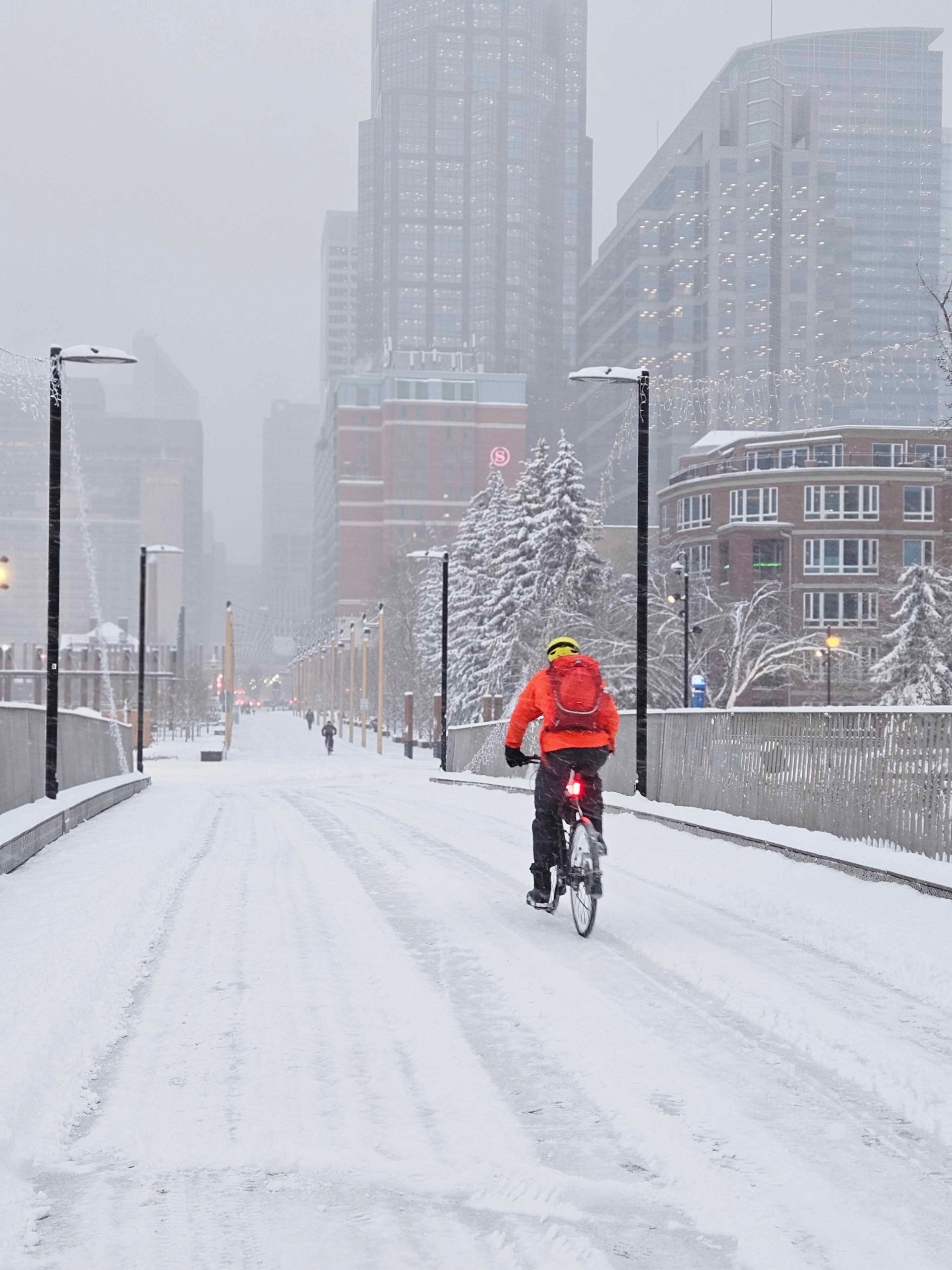
However early the first snow arrives in Calgary, it’s usually here to stay by late November, though you can never be sure what the Chinook winds may do. The majority of recreational cyclists stop riding for the season once the temperature drops below 5⁰C, even before that snow arrives. I can confirm this by observing the pattern of use in the bike room of my apartment building. Of the fifty or so cycles stored there, only two or three won’t be gathering dust for the next 6 months.

Despite the dearth of causal riders, a hard core of commuters continues to ride into downtown year-round. The bikes they use range from fat tire electric bikes to skinny tired road bikes but you frequently hear the clicking of studs on paving so some obviously change their tires for winter. Even on the bitterest mornings or when snow is flying, I see riders passing my apartment window. As the casual riders have long since stopped riding, these commuters must have chosen to cycle for reasons of convenience, economy or health.
Riding the trails outside commuting times, you tend to see few other people riding unless the sun is out, the temperature above freezing and the trails are clear. Although I try to get out in all conditions, the duration of my rides is certainly reduced by low temperatures; two or possibly three hours is enough unless I stop midway for a coffee break and warm up. Consequently, I have a selection of cozy cafés earmarked in strategic positions on the edge of the city or surrounding communities like, Chestermere, Langdon, Cochrane and Airdrie.

Even when I think I am dressed appropriately, sometimes a biting cold wind will surprise and chill me. In the past, cold hands and feet limited my rides but I have overcome this problem by investing in insulated cycling boots and handlebar “pogies”. Pogies are insulated coverings that fit over the brakes and gear shifters to shield your gloved hands. I wear fully-finger mountain bike gloves for temperatures between zero and 10⁰C but winter gloves when the temperature is below zero. Just for good measure, I drop a rechargeable handwarmer in each pogie when the temperature nudges minus 10⁰C.
Many riders keep their heads warm by wearing a ski helmet and goggles as the temperatures plunge. The extra bulk and weight of a ski helmet won’t make much different to your speed by then as you will also be wearing a heavier jacket, pants, gloves and boots. You could used heated socks in lighter boots and this combination suits those who want to continue with cleated boots. However, there are specialist winter cycling boots, from companies like 45 North, that resemble snowboard boots but which are fitted with mountain bike cleats too.

Layering is best for leg warmth as your legs are generating most of your muscle warmth while riding and if you opt for heavy ski pants you can end up sweating, particularly when the sun is out. I wear thin cycling tights over my bib shorts for temperatures between freezing and 10⁰C and thicker overpants when the temperatures drop further. Below -10⁰C, I add a polypropylene or smart wool layer under my outer cycling pants. I have cycled in temperatures in the -20⁰Cs and lower and wore skipants with underlayers on those occasions.
Surprisingly, I find my torso can get overly warm if I layer up with a down-type quilted coat before the temperature is in low negative territory. It is usually my shoulders and upper arms that feel the cold first so the popularity of sleeveless gillets has always puzzled me. If it is cold enough to need a quilted gillet, then I need some form of arm protection too. Again, I tend to layer up, initially with a long-sleeved vest under a long-sleeved cycling jacket and as temperatures drop, I will add a mid-layer, usually a mountain bike jacket. Only when the temperature sinks below -10⁰C will I consider a quilted layer under my cycling jacket.
For face protection, I rely on a winter “Buff” to cover my chin, nose for temperatures down to -15⁰C but I wear a balaclava for full face cover when its colder. I also wear ski goggles over my glasses which is fine until I have to stop at crossings and traffic lights where they start to fog up. In these sorts of temperatures, you also begin to get problems with your bike. Brake and gear cables can freeze if there is a trace of moisture in the Bowden cables, or battery shifters rapidly lose their charge. And, of course, there is the issue with to much or too little tire friction.

Very cold snow, below -20⁰C is extremely grippy with the texture of fine sand so a thin layer of this adhering to pavement causes no issues, even to unstudded tires. New studded tires will grip well on bare ice but it is the combinations of snow and ice types that we see in Calgary that are problematic. Particular care needs to be taken on roads and when crossing sidewalks.

In near freezing conditions, the weight of road and foot traffic will crush newly-fallen snow into an underlayer of hard ice. If left untreated, subsequent colder snow may not adhere but build up to a depth of many centimetres as loose snow. Even when driven on, this new snow may not pack down but just be displaced on the slippery, base layer. When a cyclist attempts to ride through this covering, even with studded tires, the loose snow resists movement turning and lifting the front wheel off the hard layer rendering the studs ineffective. The loose snow, now under the tire, slides rapidly sideways on the ice taking the front tire with it and a fall is inevitable.

The only way to avoid falling is to recognize these conditions and to avoid roads, paths and sidewalks covered in heavily churned dry snow because the first patch of ice underneath will cause trouble. Walking and pushing your bicycle here may be your best option to avoid a painful tumble. But if you have a good sense of balance, don’t let this talk of falling deter you from making use of the winter bike paths – the City and their contractors do a great job of allowing us to ride year round if we want to.
