
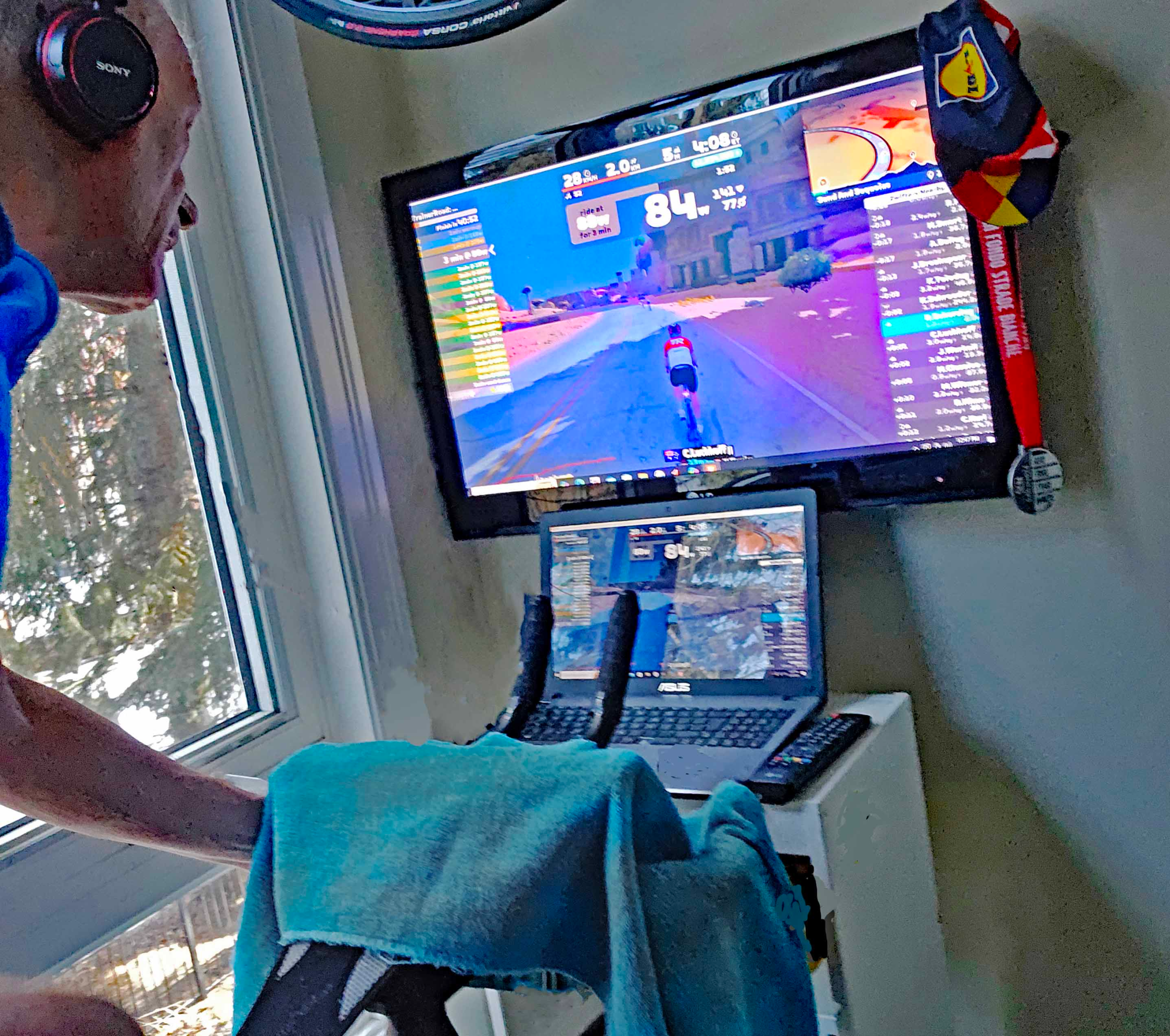
The only reason cyclists used to ride stationary indoors was to continue training during poorer winter weather. From the earliest days of the bicycle, a three-roller frame trainer was invented where the rear wheel sat between, and drove, two rollers while the front wheel rested on the forward roller. As the bike was unsupported, the rider had to maintain balance by pedalling smoothly and subtly adjusting their body position. By the middle of the 20th Century, rollers had evolved little but fixed stand versions were available and there were others where the roller resistance could be adjusted.

In parallel, the stationary exercise bike began to become popular as a general fitness machine but was not used by serious cyclists as its upright stance and pedalling motion did not emulate that of a racing bike. Essentially, you had some sort of variable friction drive and a heavy flywheel to smooth out rotation. For the causal user, who wanted to be entertained, the options were limited to watching television or playing music on the radio or stereo system. For those users actually interested in cycling there were VHS tapes of cycling events you could play on a (small screen) TV but you were never synchronized to that limited artificial environment.
The stationary bikes could record effort expended and virtual distance ridden but you had to write down what the machine had recorded and transfer the data to your paper logbook to make any meaningful training sense of what you had achieved. At the time, training knowhow was mostly the preserve of coaches and mysterious to most of us.
Indoor training began to be taken more seriously, after South African Johnny Goldberg proved a static trainer could be used in an effective program for endurance cyclists in the mid 1980’s. Ironically, his approach eventually evolved into the modern “Spinning” industry that is more geared towards general- and not cycling-specific fitness.
Then, in the 1990’s, coaching programs gradually leaked out in hard copy books by fitness icons like Joe Friel The cyclist’s training bible – Google Search. You still had to plan out you own schedule and record it manually in a note book or on early personal computers. Only serious riders had the time and interest to add this chore to their riding task.

The modern “smart” indoor trainer has its origins in the early 2000’s when companies in the US and Europe introduced models with electrical resistance control to follow training programs that were displayed on computer screens. By 2010, systems were launched that could control the bike wirelessly. However, it was Zwift’s launch in 2014 that gave indoor cyclists the new experience of being able to ride in a virtual world with others where their speed was controlled by the effort they exerted on the stationary trainer.
From the early days of Zwift there were races that have now developed into serious “e-racing” events with a world championship. Riders who were successful in the virtual world have even been selected on that basis to join real professional cycling teams. Also, some cyclists have found roles as a professional e-bike racer.

For those of us not at professional level, the social aspect of using apps like Zwift and Peloton is a big plus. Countless riders meet up in virtual groups every day for training rides or races. When my twin brother and I were going to participate in a 10-day ride from Ottawa to Halifax, we would train together for an hour a week on Zwift even though he lives in London UK. That way we could see what level of fitness each of us was at and encourage each other to stick with our programs.
Where is indoor cycling destined to go? For some it has already taken over most of their total riding effort. They can avoid the risks of riding in traffic or poor weather and still meet with similarly minded riders. As a training tool, it is more efficient and safer than working outside and you don’t have to wash your bike afterwards. Others, enjoy the social aspect of riding on Zwift, even if they are not following a specific training program. Overall, I think the level of participation on indoor platforms will tend to reflect the level of interest in outdoor riding on mechanical bikes. I write “mechanical” because I don’t think the rider who uses an e-bike exclusively is likely to consider riding indoors. I may be wrong?