
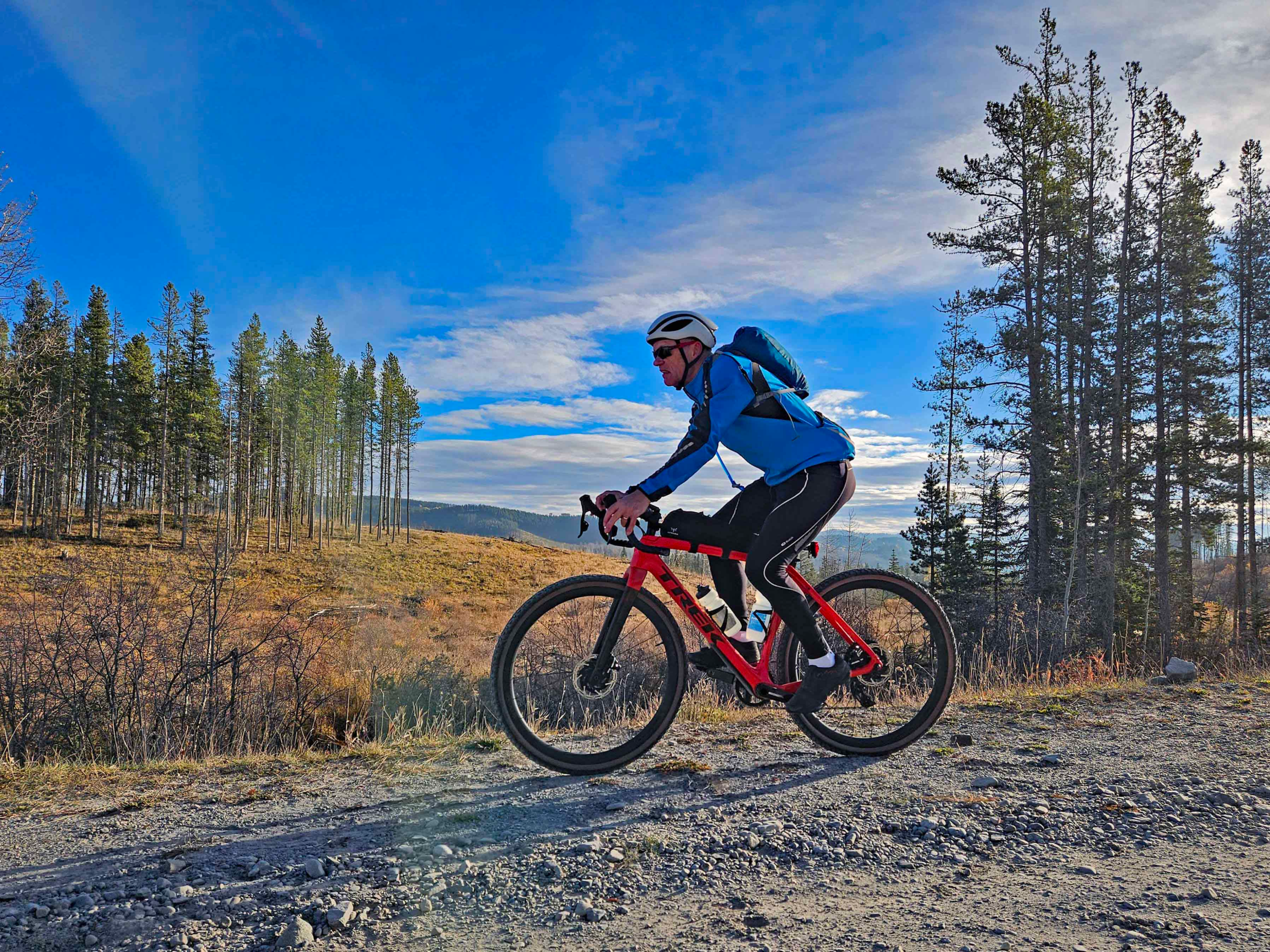
Riding gravel can be tough but once in a while, you attain a speed on a gravel road where your bike mystically rises and glides over the stones. You wish that feeling of floating would continue forever. But then you turn on to another road, sink down and go back to grinding out the slower pace you were more familiar with. A scientific explanation is illusive, bound up in “Goldilocks” blend of stone shape and size, tire pressure and speed. Whatever the cause, once felt the effect is transformative, giving you a greater appreciation of the complexities of riding off pavement and, perhaps, persuading you to return and attempt to recapture that experience on future adventures.

After a long, and usually tiring, ride on gravel I often ask myself: “How much harder was that than riding the same distance on a paved road?” So, I researched this question to try and find an answer. But I discovered this was not as straightforward as a simple percentage or distance equivalent. There are so many variables associated with gravel as it is not a consistent medium, even on the same stretch of road.


Rain can turn a fast, hard surface into a sticky morass or, after regrading a previously fast stretch may be left strewn with a new layer of marble-sized pebbles. In time, a gravel surface may crack longitudinally or degenerate into transverse washboard ridges. In dry conditions, dust from traffic can reduce visibility and treatments of chloride intended to damp down dust will temporarily produce a cloying mess on tires and drivetrain.
Despite the difficulties in giving a definite figure, I will do my best because there is no denying that riding gravel is invariably tougher than riding on paved roads. Here, there is little point comparing the speed of gravel bikes against road bikes on pavement as some people have. Surprise, surprise, they are slower! Similarly, only a masochist would consider running a true road bike on gravel so what we need to compare are the right tools for the right job; a lightweight carbon road bike on paved surfaces and a lightweight carbon gravel bike on gravel.

I have a Bianchi Infinito carbon road bike and a Trek Checkpoint carbon gravel bike that I have ridden with the same Garmin RS 100 pedals. These pedals provide single-sensing power so if I go back through old Strava files, I should have some data for comparing the performance of a road bike on pavement with a gravel bike on gravel. Looking at the files, I had to confirm my road cycling was not on as part of a group ride. I often ride with a club group on the road but not on gravel. Any group aerodynamic advantage would tend to make road riding appear even easier. I also had to try to eliminate any advantage derived from wind or slopes.
Here’s a couple of rides that are reasonable examples to compare. The first shows 10km on gravel north east of Calgary while the second is from 6km on paved roads to the northwest. Power averages are comparable, 119W on the road and 116W on gravel and my average heart rates are both 128 beats per minute. For the paved road the average speed is 27.0kph while on gravel it was 22.3kph, 17.5% slower. This means you consume 17.5% more energy to cover the same distance as well as taking that much longer. To achieve the same speed a power calculator like CFM Calculator Cycling Wattage Calculator suggests I would need 159W or 37% more power.


My gut feeling is this appears about what I would have expected for solo riding on a flat road with no significant wind influence. However, the figure seems underestimate the effort needed for a long ride.
In the real world, there are additional factors from riding on gravel that need to be added into the calculations. These include the vibration loading on your arms, shoulders and neck that your musculoskelatal system needs to stabilize. The additional energy you consume in your upper body is noticeably greater riding on gravel.
Also, there is the mental energy you expend chasing the best line down the road. Sometimes the best line is the hardpacked margin that missed the spread of new road stone though this frequently turns to soft dirt forcing you back to seek out worn tracks nearer the road centre. On double wide roads there is sometimes a bald trail on the crown of the road that runs fastest but you have to remain alert to traffic from in both directions. Your brain is constantly processing inputs and choices, again demanding more energy than it would if you were pottering down a on a smooth, paved road.
On the plus side though, the mental stress of dealing with motor vehicles can be lower on gravel roads as traffic is sparser and slower than on busy highways. Even so, the net mental energy loading is probably higher on gravel than on the type of rural paved road where we generally try to ride.
When you add together the additional mental energy with the energy required for upper body stability and the energy needed to power over the surface, it’s easy to see why some riders believe a gravel ride is equivalent to a ride of 20% to 50% longer on a paved route. (Is Gravel Riding Harder Than the Road?). In extreme terrain, like hilly single-track or sticky mud, that multiple could be much higher. When I ride the single track on Nose Hill in Calgary, a 20km ride can seem like 40km to 50km on the road.

I think the key difference between gravel and road cycling is there is a minimum “power buy-in” on gravel just to get moving. Sometimes this means that you have to pedal just to maintain forward speed on downhills where on an equivalent grade of asphalt your road bike would continue to accelerate until aero drag balanced the force of gravity. On flat roads this “power buy-in” flavours more powerful riders, which usually means bigger riders. However, on hill climbs, being lightweight is still the advantage it is in other cycling disciplines, provided that extra “power buy-in” is not too great a percentage of your long-term power output (or Functional Threshold Power).
How much harder is riding on gravel? From my experience, for the type of gravel roads you could drive a car along, I estimate you will go 20% slower or need 40% more power to maintain the same speed. And if you ride for more than a few kilometres, each kilometre will seem like 1 ⅓ road kilometres by the time you have finished. Go out there and compare the differences yourself!