
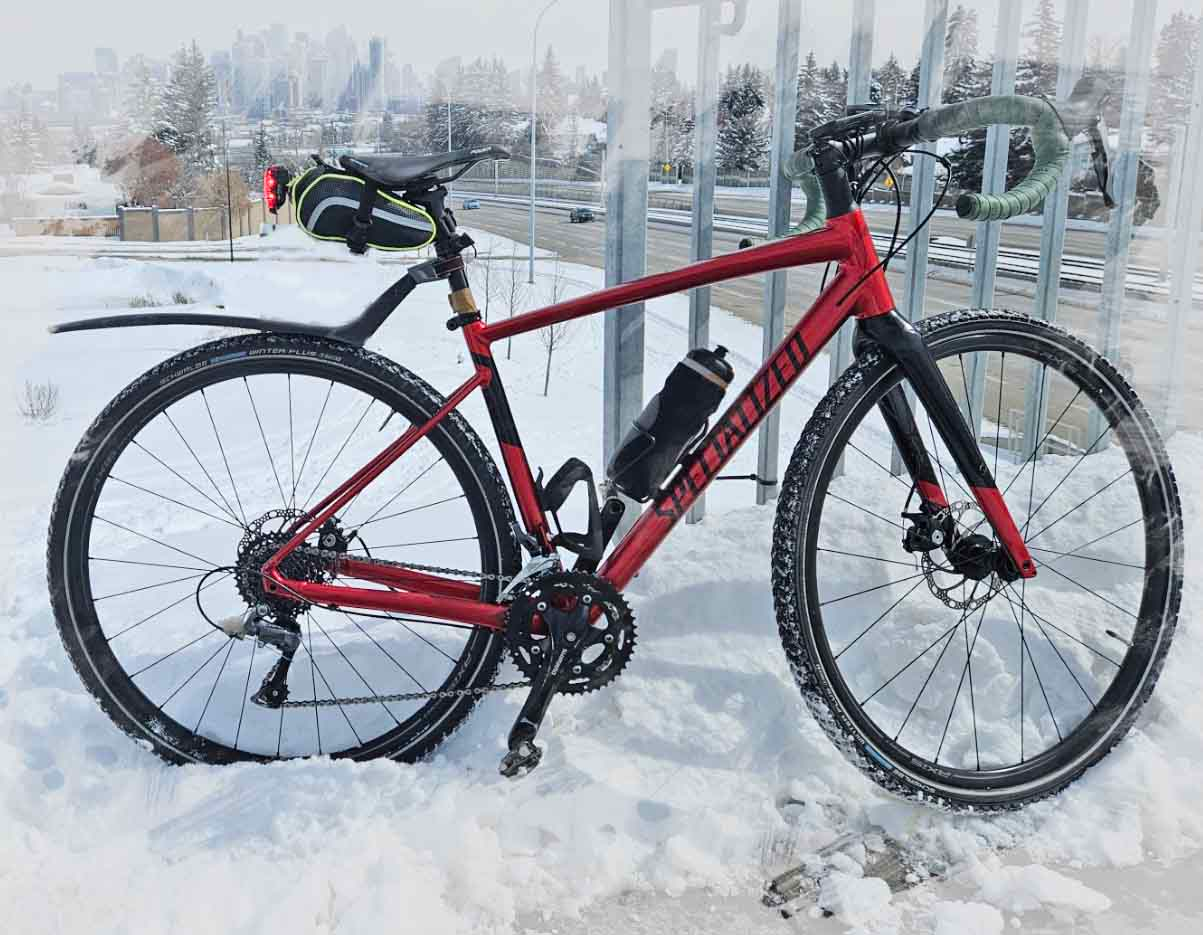
Until I moved from BC to Calgary, I didn’t even know studded tires were a thing for bikes. Sure , I had seen them on cars and even some motorbikes when people from the more mountainous parts of the province ventured down to what we called “the Lower Mainland” in winter. Many people living on the flat lands of the Fraser Valley never bothered to change to winter-specific tires let alone studded tires. This was always evident during my daily commute when the first snow fell and countless pickup trucks ended up in the central median of the Trans-Canada Highway.
My local bike shop, here in Calgary gave me the pros and cons of studded tires when I was setting myself up to ride “for pleasure” through a real Canadian winter. Even though I had lived in Ottawa for four years where there were real winters, I had never contemplated commuting there by bike in winter. However, here in Calgary, there are so many bike paths, separate from car traffic that are ploughed free of snow so it is easy to enjoy cycling year-round.

I initially questioned the need for studded tires with such infrastructure until I experienced the freeze-thaw conditions that came from an unexpected Chinook wind. The Chinook and bright sunshine melted banks of snow at the edge of the bike path and once the Chinook abated, the film of water froze to black ice overnight.
On normal tires, you can ride over ice unhindered, but only if you remain upright, travel in a straight line and don’t brake. It isn’t long though before you can’t meet all these conditions and experience a fishtail or worse. This should be enough to convince you that studs are a good investment.

So how do tires with studs actually run? I use 40mm Schwalbe Marathon Winter Plus that have 240 tungsten carbide studs. When you swap out flexible summer tires, you first notice how much heavier studded tires are. They can be somewhat harder to fit on the rims and you may want to wear tough gardening gloves to grip and pull the tire as new studs can be harsh on bare skin. Also, if you wear Gortex overboots or big winter boots, you need to be extra vigilant when turning the front wheel as the rotating studs will readily shred any material they come into contact with.
Riding on concrete and asphalt is certainly noisier on studs as there is a definite background hiss. I’ve never noticed any reduction in control but then I wouldn’t push these tires on hard cornering whatever surface I was riding on. They really come into their own where you encounter sloping, smooth ice either uphill or across the path. Here you can confidently traverse treacherous conditions that would be tricky or even dangerous if you tried to walk and push a bike with conventional tires.
On pure snow, studs do nothing; tire pressure, tread and width are all important for maintaining traction there. Studs are good on frozen dirt trails, like those in Nose Hill Park and where snow has been compressed to a thin hard layer but not on deep snow.

So how much slower do studded tires roll? This is a valid question but the answer is not so straightforward in real life conditions because the studs allow you to maintain speed where you may otherwise have slowed on ordinary tires. For the same power output that would roll you at 22kph on a bare cycle path, you would probably lose 1 to 2 kph on studs. In mixed conditions of snow, ice and bare roads, the speeds of both tire types are probably comparable but the likelihood of a slip is much higher without studs.
When do you change over to studs and would I change back to stud-less tires in winter for a long ride where I knew the surface was bare? Firstly, when to start riding on studs. If you use winter tires on your car, this is pretty much the same question and often the answer for people is immediately after the first snowfall. Often that is too late as the spate of accidents that first day of snow will confirm. You could leave the changeover to the night before the first expected snowfall or a day or two in advance of that just to avoid being caught out. Don’t remove them until after the freeze-thaw cycle is over in late April or even early May in Calgary.

And, would I revert back to normal tires if I knew the surface would be bare for a while? I maintain a gravel bike without studs for most of my summer off road riding though in winter, it normally hangs up in my bike room. As I run tubeless tires on that bike, I would have to consider the state of the sealant that has a limited usable life so, I would probably opt for a road bike with innertubes to save the hassle of sealant or swapping tires just for one ride. If you have just one bike and you are riding with others, then change the tires to match what they are choosing. If you are riding solo, then its up to you if you don’t mind the slower speed and wear on your studs.

Specialist Manufacturers like 45 North suggest studded tires should last 4 seasons of typical commuting which sounds like quite a few kilometres! So, when do you need to replace studded tires? Road tires have a wear dimple to indicate minimum rubber thickness but what about studded tires? The simple answer is there is no obvious wear limit; while they continue to provide grip, they are good to use. Most winter tires have extra thick casings too so this adds to their durability.
Are special studded tires worth the investment? Certainly. If you are choosing to ride in winter, you will have already invested in suitable cold weather clothing for comfort. Studded tires give you confidence and an added level of safety that normal tires simply cannot emulate. Anywhere, that experiences winters with long periods of snow, ice or freezing rain are locations where I would recommend trying studded winter tires.