
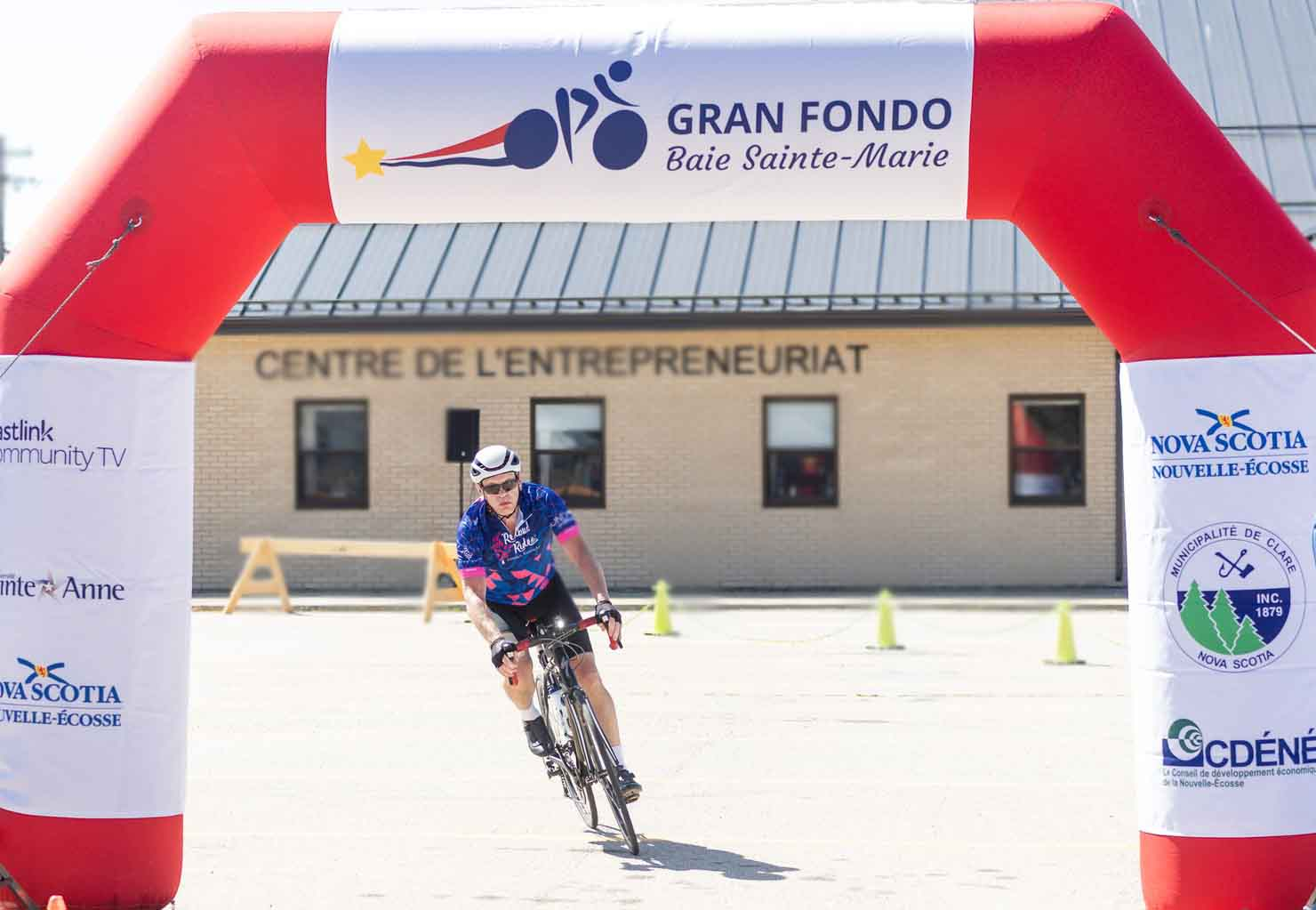
When you travel 3,700km across the country for a cycling event, you always wonder whether the time and cost will be worth it, or whether you should have ridden your last fondo of the year somewhere locally. However, I had read good things about the Gran Fondo Baie Sainte-Marie that is held along the Arcadian shore of eastern Nova Scotia. This year was the tenth anniversary although there had been a three-year hiatus because of the Pandemic from 2020-2.
Flying into Halifax, we were around 300km from the Baie Sainte-Marie coast and had decided to spend a few days before the event on the Bay of Fundy shore. I had brought my Roubaix road bike with me and started to reassemble it on our deck overlooking the ocean as soon as we reached our cottage accommodation. Somehow, I managed to graunch the thread in the derailleur hanger while re-attaching the derailleur but I salvaged enough to gorilla it on adequately for my big ride. Fixing that would have to wait for my return to Calgary.

My first short foray into the surrounding countryside included some 10km on gravel roads that were unavoidable if I wanted to ride a loop. Roads running parallel to the coast linking the tiny settlements appeared mostly to be unpaved, while the paved roads were those running from the highway the coastal villages.. Even these roads were in poor condition and contained numerous ruts, dips and sunken sections. On one steep wash-boarded climb, I had to get off and walk up the gravel as I had insufficient traction on 28mm Continental 5000 tires.

Two days before the Gran Fondo, I rode a different loop of 20km where there was only a few km of gravel. The bike rode well and seemed correctly adjusted so, afterwards, I only needed to clean the grit from my chain to be ready for the fondo. I had fitted a small top-tube bag for gels and Veloforte energy bars and a saddle bag with two innertubes, gas and tools. I was intending to use my back light but wasn’t sure I’d need the bell and front light if I could get myself into a fast-moving group.

We took accommodation nearer the Gran Fondo start on the Friday night, an Airbnb camper trailer parked by a lake a few kilometres inland from the Baie Sainte-Marie coast, that looks out toward New Brunswick and the US state of Maine. We were enjoying late summer sunshine that wasn’t helping with the drought situation or the continuing wildfire threat but was great for tourists. Luckily, the one large fire in the Annapolis Valley had finally been brought under control the day before and we never saw or smelled smoke.

From 11am to 5pm the day before the event you could pick up your race number, bike tag transponder and bike jersey. The University Sainte Marie was the registration location and would host the start and finish of the ride. Everything was efficiently organized from the parking direction to the pick up though I felt a bit strange walking up to the stage to sign in and pick up my swag. I hadn’t gone onto a stage to receive anything since high school prize-giving on a hot July day fifty years ago!
As well as the university students, a good number of the local community was helping at the event l, proudly sporting their purple volunteer T-shirts. I wasn’t that sure where I would be parking or assembling the next morning but felt confident these folk would be pointing me in the right direction.
With little else to do in late afternoon, I took a kayak out for a paddle on the lake back at our accommodation and pondered my ride tactics. Having driven some of the route, I had seen the hills were mostly short kickers rising some 20 or 30 metres; the biggest climb was only 50m so it was possible I might be able to keep up with a faster group. I was usually quicker than the lighter climbers on descents so thought I should be able to catch the back of the group before the next climb.

Aid stations were going to be put out at 12, 37, 74, 97 and 116km. I had no intention of stopping at the 12 and 116km points but thought I would likely be pausing at the other three. On previous 100mile (162km) Gran Fondos, I had tended to stop at all the latter aid stations. At the Kentucky Fondo earlier that year, I had stopped at all four aid stations after the 50km point. However, I had not anticipated the strategy of the group I would find myself in on the day for this ride. As it turned out, I would need my complete stash of food that comprised three caffeinated energy gels and three Veloforte energy bars. I was going to mix two 700ml bidons with energy/electrolyte drink and carry powder for one refill, anticipating a ride of 4 ½ to 5 hours.
On Sunday morning, I was awake before dawn, having slept most of the night without waking. There’s normally some nervous tension tugging at me be before an event causing me to lose some sleep. I waited until 6:45am to rise, shower and put the kettle on for tea although I was only intending to drink a half mug; this is my ritual. There was little else I had to do other than eat a bowl of breakfast bran flakes and blueberries – another ritual. I didn’t need to depart until 7:30am.

The morning was still and bright, the air temperature about 10⁰C so arm-warmers would give me a more comfortable start. Once Jane was up and ready, we departed for the coast, a twenty minute journey covering a few kilometres of my later route. I had expected to see more cars ahead of me driving to the University but traffic from the south was non-existent. When I reached the start location, I noticed most of the traffic coming in from the north which would have been the logical route it you had got up really earlier and driven the 3 ½ hours from Halifax; I later read that 250 of the 600 entrants had hailed from Nova Scotia’s largest city.
Squinting into the blinding low sun, we made our way towards the marshalling area and I was called forward to the briefing for the long route a little after 8am. The organizing president welcomed us in a mix of French and English and the mascot, a bright red lobster wearing a yellow bike helmet, entertained by goofing with, mostly female, participants lined up at the start.

As always, I scanned the other riders and felt I wasn’t out of place three rows back from the front. The pace suggested for so-called expert and intermediate riders was 27+kph which I predicted considerably underestimated what his crowd would be riding if they organized into a peleton. I was hoping to stay in a group for as long as possible and average at least 30kph, but I wasn’t sure when I would get dropped on a climb.
The alternating French/English countdown from ten released us a short time after 8:30am and we squeezed under the now- commonplace inflated arch and onto the coast road. Fast riders raced up the road and had soon formed a critical mass of 20+ riders that broke away and continued to distance the rest of us. A slower, second group was forming just in front of me and I hitched myself onto the back wheel of a fast-moving female rider who, together with small guy in a bright pink jersey, were bidding to bridge the gap to the second group.
Once we latched onto the group, I focused on staying in the wheels and had no time to take my phone out my back pocket for photos. A glance at my head unit revealed we were pushing 35-40kph on the flatter stretches. I didn’t manage to take in the coastal scenery as we rushed through New Edinburgh but I did acknowledge and appreciate the cheers, waves and cowbells at the roadside. All along the coastal road, locals sitting in lawn chairs or leaning on rails in front of white-painted homes were waving us through.
On the first sharp rise, I applied the power up to 300W and was delighted to stay in the group. The short climb suited my method of high cadence while younger riders were dancing on the pedals. Meanwhile, acquaintances were being made and a pecking order was established. We did not stay in single file once we were off the main coastal road and headed inland. I knew from cycling Google Earth, most of the route would be through tree-lined woodland with occasional landmarks so kept and eye out for these.
Seventy-five minutes into the ride, I thought we should be somewhere near the second aid station at 37km but it was set back at a community hall a hundred metres from the road and in my focused state, I must had ridden straight past it. No-one had shown any inclination to stop which was fine with me as I had drink for perhaps 100km. I chatted with a civil engineer from Halifax for a while but he was towards the back of our pack and I wanted to be nearer the front so when I lost speed on the climbs I could still “sag” into the back of the group and regain my position in mid-pack on the descents.
Amongst our group were six or seven riders from a Halifax club who were wearing a distinctive blue jersey and one of these, rider 802 was a huge guy who was great to draft behind. I was amazed how much power he must have been punching to climb at the speed of people 100lb lighter than himself. As we made our way over climbs near the lake where we were staying that I thought they would have given me more trouble but I felt good in the group even though I was content to stay mid-pack. Most of the time, the same two or three people were pulling this group of twenty riders.
We passed the road leading to “our lake” and were making our way south into a light headwind, not that those of us hiding in the pack really noticed. I was aware the next aid station was coming up at Bangor, a former saw mill. After a little confusion at a junction where our route went right but the aid station was to our left, most of us pulled in to top up drink bottles and grab a banana or energy bar.
We regrouped after just five minutes and continued out to rejoin the coastal road again where a volunteer was holding up traffic for our turn. From there, it was a dozen kilometres to our turning point at the south end of Mavilette Bay that Jane and I had scoped out the day before. There, we’d been for a walk on the sandy beach, watched learner surfers practicing on gentle waves and driven up to Cape Saint Mary’s Llighthouse on the headland.

From a high point by Saint Alphonse Church, I knew the road went mostly downhill to a salt marsh and then kicked up to perhaps the steepest gradient of the whole route. It was on this stretch that I lost contact with the back of the group by only about 50 metres. Naively, I assumed they would all stop once we dropped back down to the aid station at beach level but no, they kept going and the damage was done. As they reformed into a pack on the flat, a couple of us just couldn’t catch up and I soon found myself isolated.
Climbing back up from the salt marsh, I could see the group gradually pulling ahead. 100m metres stretched out agaonizingly slowly to 150m and then 200m by which time I realized I couldn’t continue to push 300W to rejoin. Another of their group blew up on the climb back to Saint Alphonse and before long I had overtaken and distanced him too. For the next 30km I would be riding alone. Only when we merged with the return route for the Medio Fondo riders did I see others but they comprised the tail-enders of a 56km ride so were much slower than me.
Luckily, the southerly wind had picked up and was gifting me 5kph so I estimated I would be back before 12:30pm, under 4 hours, if I didn’t cramp up. I could feel twinges developing in my inner thighs and immediately above my knee caps. Twice before during fondos I had suffered serious cramps. In the most extreme case, in Helena, Montana, I had virtually fallen off the bike when the first attack struck and I could barely crawl back the remaining 10km to the finish where I fell on the grass and writhed in agony for several minutes. More recently, in Washington State, I had pushed myself too hard to stay in a group. On that occasion I pulled over before the finish and had to stretch out before continuing. Neither experience I wanted to repeat and I sensed standing on the pedals and straightening my legs would trigger a cramp so I just kept pedalling. This seemed to work.

Helping me along, psychologically, were the locals, still waving and cheering all along this stretch through small towns, hamlets and houses strung out along the coast. The whole Arcadian community of Clare was proudly behind their event in a way I had only previously experienced on the Strada Bianche fondo in Italy.
Slowly the kilometres ticked by as I passed the stragglers from the Medio Fondo who were completing their shorter route. Overtaking them was an incentive for me though I was more intent on beating my personal target of four hours, not that I could have achieved this without the help of the group for 96km.
The last couple of kilometres, I built up speed to almost 40kph and almost overshot the turn in through the finish arch where my arrival was announced as Ron Eckersley from Calgary, Alberta. As to be expected, most of the riders were from Nova Scotia and New Brunswick but 28 had come over from the United States, probably via the ferry from Maine to Yarmouth that was an hour south of us. Five of us were from Alberta but I didn’t know the other four.
Jane was there too to welcome me home so after stowing my bike in the car we set off for our meals. Mine was a whole lobster dinner and unbeknown to us at the time, Darlene our Airbnb host was one of the volunteers dishing them out. .Sitting in the marquee with live west coast fiddle music playing around us, I assessed this as one of the best fondos I had ever taken part in. There was a great sense of community without overt commercialism or the pressure to raise money for charity. This was sport and community for its own sake.

When I looked at my timing, I found I had completed the 128km in 3 hours 53mins at and average moving speed of 33kph with an elapsed time of under four hours.. My 100km time was the fastest I had ever ridden that distance, probably because I had never previously managed to stay in a peleton for 100km! Even on this occasion I only managed about 95km in the group but it was enough to get my average speed up to over 30kph for the first time. Consequently, I was very satisfied and considered my training over the summer had paid off.


Now for some big gravel rides in the foothills before the snows sweep in.